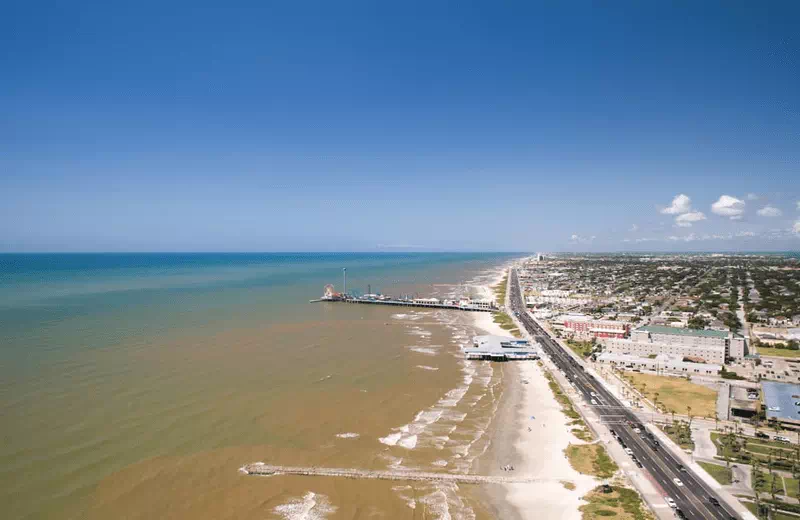
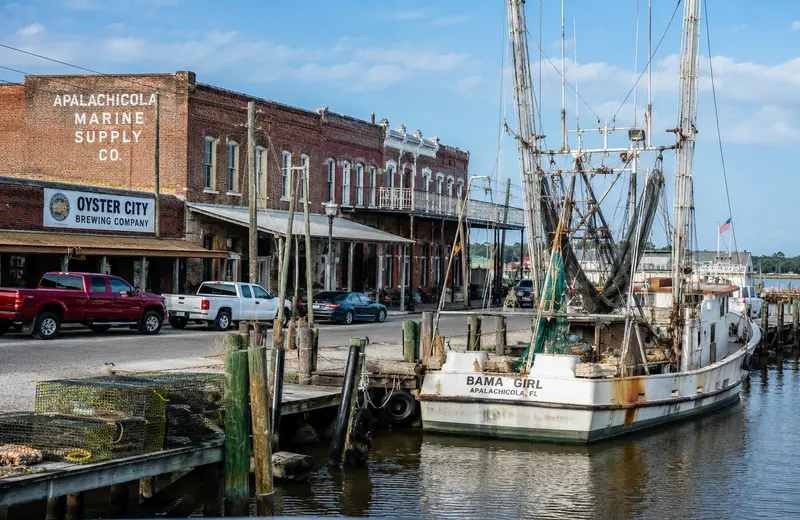
Most people drive the Florida Panhandle on their way to somewhere louder. Apalachicola is the town worth stopping for. It sits where the Apalachicola River empties into the Gulf, a working seafood port of barely 2,300 people, with brick warehouses from the cotton era, shrimp boats still tied up at the docks, and a downtown small enough to cross on foot in twenty minutes. Locals call it "Apalach." The wider stretch of undeveloped shoreline it anchors goes by a fitting nickname: the Forgotten Coast. If you want a side of Florida with no high-rises and no theme parks, this is where to start.
An Old-Florida fishing town on the Panhandle's Forgotten Coast, built on oysters, history and a pace that has not sped up to match the rest of the state.
At a Glance
| Where | Franklin County, Florida Panhandle, at the mouth of the Apalachicola River |
| Size | A town of about 2,300 people; historic district on the National Register |
| Known for | Oysters and seafood, 19th-century architecture, the Forgotten Coast |
| Nearest beaches | St. George Island, about a 20-minute drive south |
| Nearest airports | Tallahassee (roughly 1.5 hours east), Panama City (roughly an hour west) |
| Getting around | A car is essential; downtown itself is walkable |
| Best time | Spring and fall for mild weather; winter for festivals and quiet |
| Big festivals | Florida Seafood Festival (November), Apalachicola Oyster Cook-Off (January) |
Why Apalachicola Is Worth the Detour
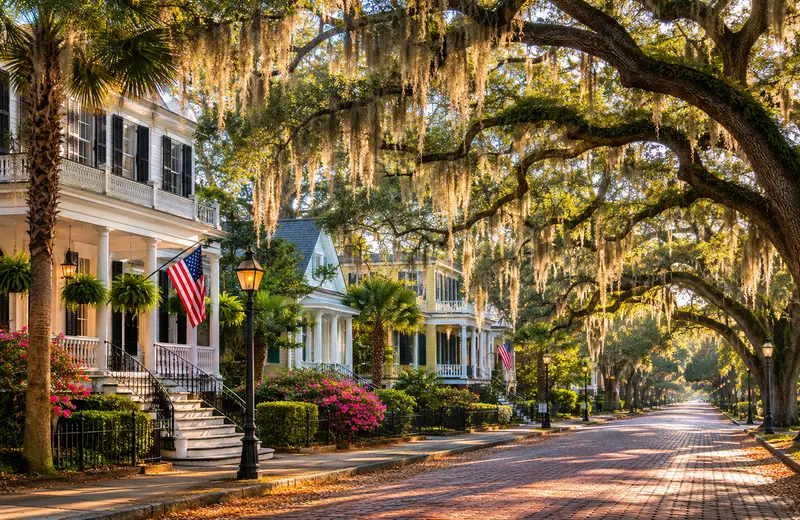
Apalachicola has lived several lives. In the 1800s it was a busy cotton-shipping port, lined with brick warehouses and broad streets running down to the water. When cotton faded, sponging and then lumber took over, and by the end of that century the local economy had settled on what it is still known for today: seafood pulled straight from the bay. That long, working history is why the downtown looks the way it does, with preserved Greek Revival homes, a chandlery building from the 1880s, and street names as plain as Water, Commerce and Market.
What sets the town apart from the rest of coastal Florida is what it does not have. There are no resort towers, no chain-restaurant strip, no spring-break crowds. The river and bay are still full of working boats rather than jet skis. You get a genuine fishing town that happens to be photogenic, with a small but real arts scene, a handful of good restaurants, and the kind of front-porch friendliness the Panhandle is known for. For travelers tired of the polished, built-up coast, that contrast is the whole appeal.
Apalachicola rewards slowing down. The best plan here is a loose one: wander the docks, eat well, drive out to the island, and let the town set the pace.
The Oyster Story: Famous, Fragile, and Recovering
You cannot understand Apalachicola without understanding its oysters. At its peak, Apalachicola Bay produced roughly 90 percent of Florida's commercial oyster landings and around 10 percent of all wild oysters harvested in the United States. The town earned the nickname "Oystertown" for good reason, and Apalachicola oysters were a name-brand product on par with Maine lobster.
Then the fishery collapsed. A mix of overharvesting, drought, and reduced freshwater flowing down from rivers in Georgia damaged the delicate brackish balance the oyster reefs need. The decline became a crisis, and the state eventually closed Apalachicola Bay to wild oyster harvesting for several years to let the reefs recover, backed by tens of millions of dollars in restoration work.
The honest picture: wild Apalachicola oysters are no longer the endless supply they once were. Harvesting has cautiously resumed on a limited, tightly managed, seasonal basis, and a lot of what you eat in town now is responsibly farm-raised. Availability and seasons change year to year, so ask locally what is fresh rather than assuming.
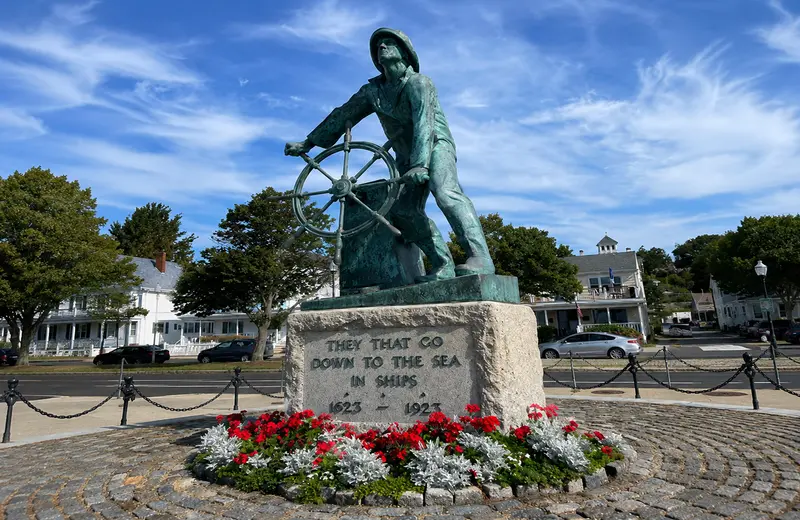
None of this means you will eat badly. Far from it. Raw bars and seafood houses still serve oysters every way you can think of, alongside Gulf shrimp, grouper, blue crab and shrimp-and-grits. Working fishing ports like this tend to take their seafood seriously, much as you would find in older American harbor towns covered in guides such as this one on Gloucester, Massachusetts. The difference in Apalachicola is how close you are sitting to the boats that brought it in.
Best Time to Visit Apalachicola
Spring and fall are the sweet spots. The weather is mild, the humidity eases off, and the town is busy enough to feel alive without being crowded. Summers are hot and sticky, the way the whole Gulf Coast is, and they fall within Atlantic hurricane season, so keep an eye on forecasts if you travel between roughly June and November.
Winter is quietly one of the best times to come. The air is cool and pleasant, the crowds thin, and two of the town's signature events land in the cooler months. The Florida Seafood Festival, one of the oldest of its kind in the state, fills Battery Park each November with fresh seafood, oyster-shucking and live music. The Apalachicola Oyster Cook-Off follows in January, raising money for the volunteer fire department while teams compete over the best oyster dish.
Exact festival dates, ticket details and event line-ups shift from year to year, so confirm them on the official event or county tourism sites before you build a trip around them.
How to Reach Apalachicola
There is no airport in town and no passenger train, so you will be arriving by road, and you will want a car once you are here. The most common approach is to fly into a regional airport and drive. Tallahassee International is roughly an hour and a half to the east, while the airport near Panama City Beach is about an hour to the west; Pensacola is a longer haul further west. From any of them, the coastal U.S. Highway 98 carries you into town along the water.
That drive is half the pleasure, because Apalachicola sits in the middle of a classic Panhandle road trip. Head west and the coast builds toward the sugar-white sand of the 30A beaches around Santa Rosa Beach and the busier, more developed shores of Destin. Keep going and you cross into Alabama's Gulf playground at Orange Beach and Gulf Shores. Apalachicola makes a calm, characterful base or an easy stop on a longer coastal loop.
Things to Do in Apalachicola
The first thing to do is simply walk the historic district. A self-guided walking route links dozens of marked sites, most of them clustered close together, including the 1838 Raney House and the small Apalachicola Maritime Museum. One stop with a surprising backstory is the John Gorrie Museum State Park, which honors a local physician who pioneered mechanical ice-making and refrigeration in the 1800s, work that helped lay the groundwork for modern air conditioning. The downtown is also dotted with galleries, an independent bookstore, a chocolate-and-coffee shop and small boutiques, and it hosts regular art walks where you can meet the makers.
When you want sand, drive about twenty minutes south to St. George Island, a barrier island some 22 miles long reached by bridge from the town of Eastpoint. The eastern end holds the Dr. Julian G. Bruce St. George Island State Park, where the beaches are long, quiet and backed by dunes rather than condos. It ranks among the most peaceful stretches you will find on the Gulf, and it pairs well with the wider picture in any roundup of Florida's best beaches. For something genuinely remote, St. Vincent National Wildlife Refuge sits just offshore to the southwest and is reachable only by boat, a protected wilderness of beach, forest and wildlife.
The water is the other half of the experience. This is a serious fishing region, with charters running for everything from inshore redfish to offshore grouper and snapper, plus easy kayaking and paddleboarding on the rivers and bay. Boat tours head up the Apalachicola River through cypress and marsh, and you have a good chance of spotting dolphins and birdlife. Inland, the vast Apalachicola National Forest, the largest in Florida, offers trails and wildlife watching for anyone willing to drive a bit.
Where to Stay and What to Eat
For somewhere to sleep, the landmark choice is the Gibson Inn, a restored early-1900s hotel right downtown with wraparound porches and a well-regarded restaurant of its own. Beyond that, the town runs to charming bed-and-breakfasts, historic guesthouses, a waterfront hotel or two, and a good supply of vacation rentals, including cottages out on St. George Island if you want to wake up by the beach. Staying central keeps the shops, docks and restaurants all within an easy walk.
Eating is the easy part. Casual raw bars and waterfront spots serve oysters, fried shrimp baskets and fresh Gulf fish, while a couple of more polished kitchens turn local seafood into something dressed up, including French and other global touches. Mornings call for a strong coffee and a pastry from the local roaster, and seafood markets in town sell the day's catch if you have a kitchen to use. Menus, hours and which places are open vary with the season, so it is worth checking ahead or simply asking where the locals are eating tonight.
Practical Travel Tips for Apalachicola
A few things make a visit smoother. You will need a car to reach the island, the refuge and the forest, even though the downtown core is best explored on foot or by bike, and the Gibson Inn even lends guests bicycles. Cards are widely accepted, but carrying some cash is handy at the smallest seafood shacks and market stalls. The town is relaxed and welcoming, including toward dogs, so it suits a road trip with a pet.
Pack for warm, humid weather with light clothing, reef-safe sunscreen and insect repellent, since the marshes mean bugs near dawn and dusk. If you visit in the warmer half of the year, stay aware of the tropical weather outlook and have a flexible plan. And because the famous local oysters now come and go with managed seasons, treat any "fresh wild Apalachicola oysters" promise as something to verify rather than assume.
If your trip is part of a bigger Florida itinerary, Apalachicola contrasts nicely with the state's more famous historic destination further east, St. Augustine, giving you two very different windows into Old Florida on one trip.
The Takeaway
Apalachicola is not trying to impress anyone, and that is exactly why it works. A real fishing town with deep oyster roots, a walkable historic core, empty barrier-island beaches a short drive away, and a slower rhythm than almost anywhere else on the Florida coast. Come for a long weekend, eat the seafood, walk the docks at sunset, and drive out to St. George Island at least once. The simplest next step is to pick your dates around the mild spring or fall, book a downtown room or an island cottage early, and string the town into a Panhandle road trip so the drive becomes part of the fun.