Most people who land near Phuket point themselves straight at a beach. Sand, a longtail boat, maybe a day trip out to the islands. The forest behind all that coastline barely gets a look. Ton Prai Waterfall is what you find when you turn inland instead: a roughly 40-metre sheet of water sliding down dark, steep rock at the end of a root-laced trail, with a deep green pool waiting at the bottom. It sits inside Khao Lampi-Hat Thai Mueang National Park in Phang Nga, far enough from the resort strip that on a quiet weekday morning you might have the place close to yourself.
A tall rainforest waterfall in Phang Nga, reached by a short jungle walk, that stays gloriously empty while everyone else crowds the beaches.
| At a glance | Details |
|---|---|
| Where | Thai Mueang District, Phang Nga Province, Thailand |
| Inside | Khao Lampi-Hat Thai Mueang National Park |
| The waterfall | A single steep cascade, around 40 m, the park's largest |
| Trail to the falls | About 600-650 m through evergreen rainforest |
| Walking time | Roughly 10-15 minutes each way, easy to moderate |
| Swimming | Yes, deep pool at the base; rocks are slippery |
| Best season | Rainy months (about May to November) for full flow |
| Opening hours | Daylight hours, roughly morning to late afternoon (confirm locally) |
| Entry | A park ticket that also covers Lampi Waterfall the same day |
| Nearest airport | Phuket International (HKT), about an hour away |
When the Water Actually Roars: Best Time to Visit
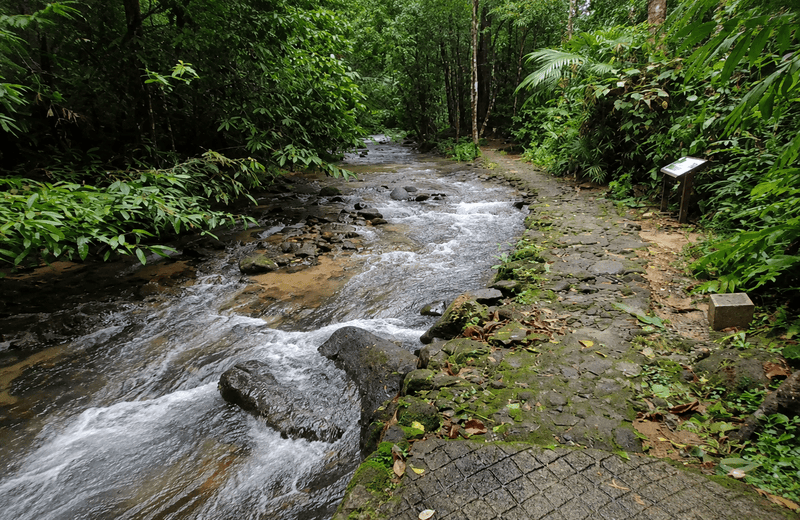
Ton Prai changes character with the rain. Through the wet months, somewhere around May to November, the stream swells and the falls turn into a loud, white rush you can hear before you see it. Come in the dry season and the same rock face shows a thinner, gentler flow, still pretty but a long way from dramatic. If you have a choice, go after a good spell of rain.
Time of day matters as much as the season. Mornings are cooler, the light filtering through the canopy is softer for photos, and you beat both the midday heat and the small afternoon crowd that drifts in. The walk back uphill is far more pleasant before the air turns sticky.
Plan a morning visit during or just after the rainy season. That single choice does more for both the waterfall and your photos than anything else on this list.
One honest caveat: heavy rain makes the rocks and trail slicker, and the current at the base gets stronger. Beautiful, but worth a little extra care.
How to Reach Ton Prai Waterfall
The waterfall sits in the mainland part of Phang Nga, between Phuket and Khao Lak, which makes it an easy detour rather than a long expedition.
The nearest gateway is Phuket International Airport (HKT). From there you cross the Sarasin Bridge onto the mainland and head north; the falls are roughly an hour's drive, sitting a little south of Khao Lak town. If you are basing yourself in Khao Lak, reckon on about 40 minutes south by car or scooter.
The turn-off is the part to get right. Coming from Thai Mueang town, you follow Highway 4 and turn inland between roughly the Km 28-29 markers, then carry on a few kilometres to the park entrance for Ton Prai. The companion waterfall, Lampi, has its own turn slightly further along, so it helps to have the spot pinned on a map before you set off.
There is no train or public bus that drops you at the gate, so realistically you have three options: a rented scooter if you are comfortable on Thai roads, a private car or taxi, or a tour that bundles the falls with other Khao Lak sights. If you would rather not rent your own vehicle, it is worth reading up on reaching out-of-the-way places in Thailand without a car before you plan the day. First-timers nervous about driving in an unfamiliar place may also find this guide to getting to remote Thai spots safely reassuring.
The Walk In: What the Trail Is Really Like
This is half the experience. The path from the parking area runs about 600 to 650 metres through proper evergreen rainforest, and in places it is less a path than a tangle of tree roots woven so thickly they form their own walkway alongside the stream.
Big hardwoods like yang and takhian, clumps of bamboo, ferns spilling over the edges. The stream keeps you company the whole way, sliding between rocks and pooling in spots where you could happily stop.
It is not a hard hike. There is no scrambling or rock climbing, and the trail is reasonably maintained, which is why families with older kids manage it fine. That said, it does rise and fall, the surface is uneven, and after rain it gets genuinely slippery. Flip-flops are a bad idea here.
Keep an eye out as you go. The shallows near the car park are full of fish that locals feed, so they gather in numbers. People have spotted lizards basking on the path and butterflies working the damp patches. Phone signal tends to fade once you are deep in the trees, so let someone know your rough plan and do not count on data at the falls.
The Waterfall and the Pool: Can You Swim?
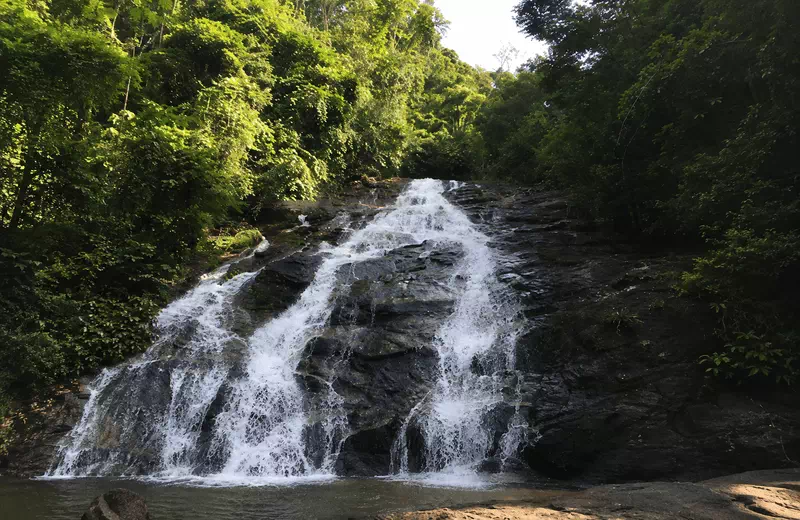
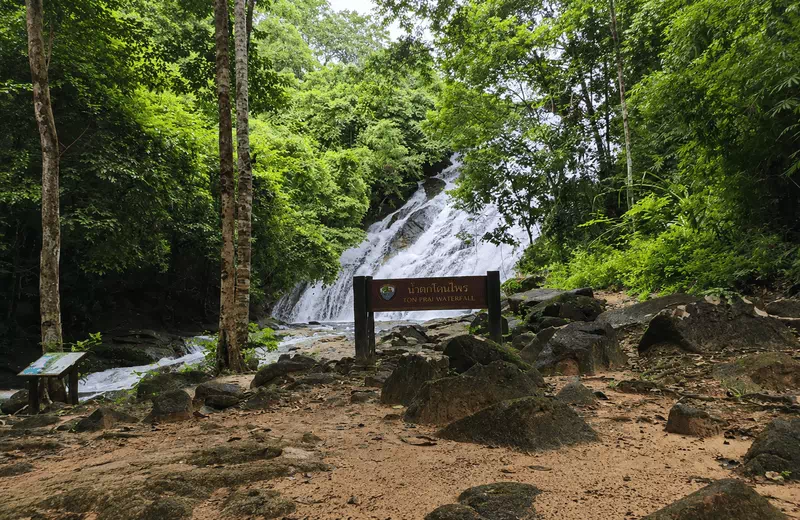
You hear it before the trees open up. Ton Prai drops in one long, steep run down a dark rock face, the water spreading thin and veil-like rather than crashing straight down, which gives it a softer look than the height suggests. At around 40 metres it is the biggest waterfall in this park.
At the base sits a wide, deep pool, and yes, swimming is the whole point for most visitors.
After a hot, humid walk in, sliding into cool jungle water is hard to beat. Two things to respect, though: the rocks around the edge and underfoot are slick with algae and constant spray, and in full flow the water below the cascade pushes hard. Water shoes or anything with grip make a real difference, and it is smart to keep small children well away from the strongest current.
Pack water shoes or grippy sandals. The rocks here are permanently wet and far more slippery than they look, and good footwear is the difference between an easy swim and a nasty slip.
You do not need hours. Many people find 30 to 60 minutes at the pool is plenty, especially if you are pairing it with the park's other waterfall.
Two Waterfalls, One Ticket, and a Turtle Beach
Here is the detail that makes the trip better value than most realize. Your single park entry covers the whole of Khao Lampi-Hat Thai Mueang National Park for the day, so you can fold in Lampi Waterfall on the same ticket. Lampi is gentler and lower-volume than Ton Prai but falls in several tiers, holds water year-round, and sits a short walk from its own car park, with a little suspension bridge that has become a favourite photo spot.
The park has a whole other half too. The coastal Hat Thai Mueang section is a long stretch of quiet, white-sand Andaman beach backed by mangroves, and it is a protected sea-turtle nesting ground. Turtles come ashore to lay eggs roughly between November and February, and each year around March the park runs a festival to release hatchlings back into the sea. If your timing lines up, it turns a waterfall day into something more memorable.
Do both falls and the beach in one visit. Paying once and seeing Ton Prai, Lampi, and a turtle-nesting coastline in a single day is the best-value plan in this part of Phang Nga.
Fees, Hours and What a Day Costs
This is the area to treat loosely, because national park rates and times do change and are set by the authorities, not posted reliably online. As a rough picture: foreign visitors have typically paid around 100 baht to enter, with reports of higher rates during peak periods, while Thai nationals pay a lower local rate. There is usually a small parking charge on top. The park generally runs on daylight hours, opening in the morning and closing in the late afternoon.
Treat any fee or timing you read online, including here, as a guide only. Check the current rate and hours at the gate or with an official source before you go, since these are adjusted from time to time.
Beyond the ticket, a day here is cheap. Your real costs are getting there and food. A scooter rental, fuel, the entry fee, and a simple lunch will still leave you change from what a single island tour would cost, which is part of why the place rewards independent travellers.
Tips Worth Knowing Before You Go
Bring more water than you think you need; the walk is short but humid, and there is no shop at the falls. Carry some cash, since the entry booth and nearby food stalls will not be taking cards. Quick-dry clothes, a towel, and a dry bag for your phone all earn their place, and mosquito repellent is sensible once you are in the trees.
Footwear is the thing people get wrong most often, so it bears repeating: closed shoes or grippy sandals, never flip-flops. Pack out whatever you bring in, since this is a working conservation area and not a resort with cleaners following you around. If you want to tread lightly more broadly on your trip, this guide to travelling responsibly in Thailand is a good companion read.
Photographing Ton Prai
The best frames come early, when light slants through the canopy and the spray catches it. The tall, narrow shape of the falls suits a vertical shot, and including a person near the pool gives a sense of just how high the water runs. If you can steady your phone or camera on a rock, a slightly longer exposure smooths the water into that soft, silky look. Protect your gear from the constant fine mist, keep a cloth handy for the lens, and watch your footing before you watch your screen.
Where to Stay and Eat
Almost nobody stays at the waterfall itself, though the park does offer simple bungalows and rented tents for those who want a night among the trees, at modest rates that vary by season. Most visitors base themselves in Khao Lak, a low-rise, family-friendly stretch of coast with everything from guesthouses to beach resorts; its beaches and resort areas make a comfortable home base for exploring the park. If you would rather stay on the island side, Kata Beach in Phuket is about an hour away and works as a day-trip launch point. Travellers chasing something quieter and closer to local life might prefer one of the affordable eco homestays in rural Thailand.
For food, Thai Mueang town near the park has simple, fresh seafood restaurants, and the beach side of the park has a few too. Eat where the local families eat and you will rarely go wrong.
If the jungle leaves you wanting more of the wild side of Phang Nga, the boats out to the Similan Islands leave from this same coast and pair naturally with a day in the national park.
Wrap-Up
Ton Prai Waterfall is not trying to be a spectacle, and that is exactly its appeal. A short walk through real rainforest, a tall cascade you can hear before you see, a cool pool to drop into, and a ticket that quietly throws in a second waterfall and a turtle beach. Go in the morning, go after rain if you can, wear shoes that grip, and confirm the current entry details before you set off. Then point yourself inland instead of at the sand, and find out what most beach-bound visitors drive straight past.