
Two people land in Goa on the same flight and have completely different holidays. One spends the week at beach clubs in Baga with EDM until sunrise. The other barely leaves a quiet stretch of sand in the south, book in hand, the loudest sound being a fishing boat. Same state, opposite trips. That gap is the whole reason the North Goa vs South Goa question matters so much, and why picking wrong can quietly ruin an otherwise good week.
This is not a "both are lovely, follow your heart" piece. The two halves of Goa attract different crowds, charge different prices, and run on different clocks. Below is a straight comparison of beaches, nightlife, stays, budget, and even which airport to fly into, so you can match the right side to the kind of trip you actually want.
A practical, honest comparison of North and South Goa to help you decide where to stay before you book a thing.
The one-line answer: North Goa is louder, cheaper, and built for action. South Goa is calmer, pricier, and built for switching off. Everything else is detail.
At a Glance: North Goa vs South Goa
| Factor | North Goa | South Goa |
|---|---|---|
| Vibe | Lively, social, fast | Quiet, slow, restful |
| Best for | Parties, groups, first-timers, budget | Couples, families, solitude, luxury |
| Beaches | Busy, full of shacks and sports | Long, clean, often near-empty |
| Nightlife | Clubs, beach parties, casinos | Beach-shack dinners, live music |
| Stays | Hostels to mid-range, lots of budget | Resorts and boutique, fewer cheap beds |
| Crowd | Younger, larger groups | Families, international slow travellers |
| Getting around | Short hops, everything close | More spread out, longer drives |
| Nearest airport | Mopa (GOX), in the north | Dabolim (GOI), in the south |
The Core Difference, Explained
Goa is India's smallest state, a former Portuguese territory until 1961, with a coastline packed with beaches stacked one after another. The capital, Panaji, sits roughly in the middle and acts as a natural dividing line. North of it, the coast grew up around tourism early and leans commercial and energetic. South of it, the beaches stayed quieter, the resorts got fancier, and the pace dropped.
The driving distance between, say, the northern party belt and the southern quiet beaches is only around 40 to 50 km, usually an hour to ninety minutes by road. Close on a map, far apart in feeling. Most people pick one base and rarely cross over, which is exactly why getting the choice right at booking time decides the texture of your whole holiday.
North Goa: Loud, Social, and Always Awake
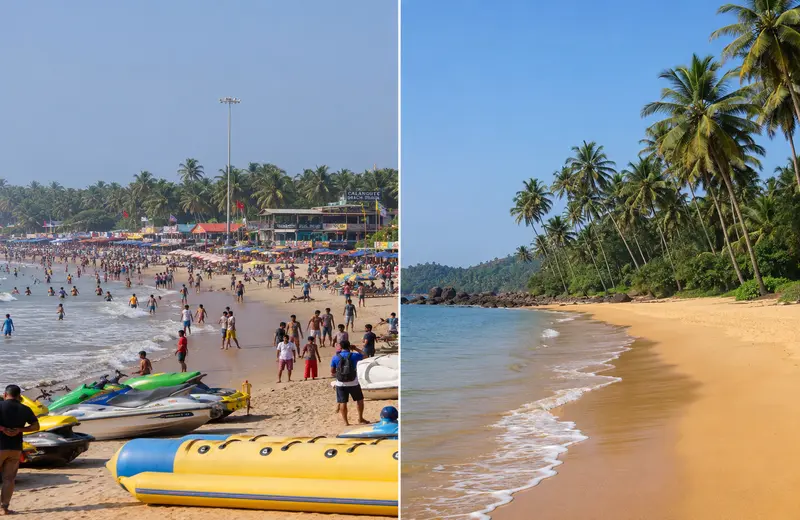
North Goa is the version most first-timers picture. The beaches from Candolim through Calangute to Baga run into each other in one long, busy strip lined with shacks, sun loungers you can use if you buy a drink, and a steady hum of water sports. Parasailing, jet skis, and banana boat rides are everywhere along here. The crowd skews young, the groups are big, and the energy rarely drops.
If you want a calmer corner without leaving the north, the beach belt has range. Candolim sits at the quieter end of the main strip, close enough to walk into the noise of Baga but far enough to sleep. Push much further up and the mood shifts again around Arambol, the long-time favourite of backpackers, yoga drop-ins, and slow travellers who want cheap huts over polished resorts.
North Goa also holds more of the sightseeing. Fort Aguada looks out over the Arabian Sea, the Anjuna Flea Market and the Saturday Night Market at Arpora are the big shopping draws, and Panaji's old Latin quarter of Fontainhas gives you Portuguese-era streets and good cafes when you tire of sand.
Pick North if: you are travelling in a group, it is your first Goa trip, you want nightlife within walking distance, or you are watching your budget. It packs the most into the least effort.

South Goa: Quiet, Clean, and Slow on Purpose
Cross below Panaji and the coast empties out. The beaches here are longer and noticeably cleaner, often with stretches where you can walk ten minutes from the last shack and have the sand to yourself. Palolem, with its curved bay and calm water, is the best-known southern beach and a good first base, while Agonda nearby stays even quieter and draws the yoga-and-hammock crowd. Colva, Benaulim, Varca, and Cavelossim spread out further down, backed by Goan-Catholic fishing villages and the occasional five-star resort.
The trade-off for all that calm is cost and convenience. South Goa is where the high-end resorts, private villas, and boutique stays cluster, so the average room price runs higher and genuine budget beds are harder to find. The beaches are also more spread out, so you do more driving to hop between them.
Beyond the sand, the south leans into nature and heritage rather than nightlife. Cabo de Rama fort gives you cliffs and sea views, Cotigao Wildlife Sanctuary appeals to the trekking-and-birds set, and the villages keep a slower, more lived-in feel than the tourist machine up north.
Beaches Head to Head
The honest summary is that North Goa beaches are about doing things and South Goa beaches are about doing nothing. Up north you get action, food, and people. Down south you get space, cleaner sand, and quiet.
| North Goa beaches | South Goa beaches | |
|---|---|---|
| Known names | Baga, Calangute, Anjuna, Vagator, Morjim, Candolim | Palolem, Colva, Agonda, Benaulim, Varca |
| Atmosphere | Crowded, energetic | Spacious, peaceful |
| Water sports | Plenty | Limited |
| Cleanliness | Busy, more litter in peak season | Generally cleaner |
| Best for | Fun, socialising, sports | Relaxing, swimming, long walks |
If your idea of a good beach day is renting a lounger next to a speaker, the north wins easily. If it is reading until you fall asleep with nobody around, head south. For travellers who want the southern calm without the southern price tag, there are quieter pockets up north too, and this guide to the area's more peaceful and secret beaches is worth a look before you commit.
Nightlife: Sunrise Parties or Starlit Dinners
This is where the two sides split hardest. North Goa is the party capital, full stop. Clubs like Tito's, Mambo's, and Club Cubana, the floating casinos off Panaji, and the beach parties around Anjuna and Vagator keep the north awake until dawn. If dancing late is non-negotiable, you simply cannot base yourself in the south and commute to it every night.
South Goa's "nightlife" means something gentler: a candlelit dinner on the sand, live acoustic music at a shack, a quiet drink under the stars. It suits couples and anyone who wants to be asleep by midnight. There is no shame in that, but go in knowing the difference. For the full picture of the loud end of the scene, this rundown of where to party in Goa maps the main clubs and zones.
Where to Stay and What It Costs
Your budget often makes this decision for you. North Goa carries the bulk of the cheap and mid-range options, from backpacker hostels around Baga and Calangute to countless guesthouses and beach huts, which is why solo travellers and student groups gravitate there. South Goa tilts toward resorts and boutique properties, so even a "mid-range" stay tends to cost more, though you get more space and calm for the money.
Food follows the same pattern. The north has endless beach shacks, cafes, and restaurants serving Goan, Indian, and international plates at every price point, and eating well on a budget is genuinely easy. A guide to the best budget beach shacks will stretch your money further on the northern strip. The south is more about unhurried meals, fresh seafood, and traditional Goan cooking in quieter settings, so try the local fish thali, prawn balchão, or pork vindaloo wherever you land.
Money note: Prices swing hard between seasons. The same hut can double in peak winter and fall sharply in the monsoon, so confirm current rates directly with the property before you book, and do not treat any quoted figure as fixed.
Which Airport: Dabolim or Mopa?
Here is the detail that trips up the most people, and the one that can cost you hours. Goa now has two airports, and they sit at opposite ends of the state.
Dabolim Airport, code GOI, is the older one, in South Goa near Vasco da Gama and roughly 30 km from Panaji. It is the natural choice if you are staying in the south, since transfers to beaches like Colva or Palolem are shorter and cheaper. Manohar International Airport at Mopa, code GOX, opened to commercial flights in early 2023 and sits up in North Goa's Pernem area, closer to the northern beach belt. The two airports are roughly one to two hours apart by road.
Before you book a flight: Check whether your ticket says GOI (Dabolim) or GOX (Mopa). Landing at the wrong end of the state means a long, pricey transfer across Goa. Match the airport to the side you are staying on.
Both airports have pre-paid taxi counters and app-based cabs, so getting to your hotel is straightforward once you land at the right one.
Getting Around Once You Arrive
North Goa is compact, and its towns sit close together, so a rented scooter covers most of it cheaply and quickly. The practical side of renting and riding is covered in this guide to exploring Goa on a scooter, which is the cheapest way to move around either side. South Goa is more spread out, with longer gaps between beaches, so you will lean more on taxis or your own vehicle and spend more time in transit.
Day trips work from either base. The famous inland waterfalls and spice plantations are reachable from both sides as a full-day outing, and there is a solid list of day trips from Goa if you want to break up the beach time. For a complete change of air, the hill country near Goa makes an easy add-on.
Best Time to Visit (and How It Changes the Choice)
The peak run is roughly November to February, with pleasant weather, full nightlife, and the busiest beaches. This is when the north truly buzzes and prices climb. The months around March to May get hotter and quieter, with fewer crowds and softer rates, which can make even the busy north feel calmer.
The monsoon, roughly June to September, turns Goa green and cheap, and the crowds thin right out. Some shacks and water sports shut down and the sea gets rough, but the lower prices and dramatic landscapes win over a certain kind of traveller. If you are tempted, there is a real case for visiting Goa in the monsoon as long as you go in with the right expectations.
Can't Decide? Do Both
If your trip runs five days or more, splitting it solves the argument. A common rhythm is two or three nights in the north for the markets, sports, and nightlife, then two or three nights in the south to wind down before flying home. You get the buzz and the calm without compromising on either, and the short drive between them is easy to fold into a transfer day.
A smart move for a split trip is to fly into one airport and out of the other if your fares allow it, so you are not backtracking across the state with your luggage.
The Verdict
There is no single winner in the North Goa vs South Goa debate, only the right fit for your trip. Choose North Goa if you want nightlife, water sports, easy budgets, and everything close together, which makes it the safer pick for groups and first-timers. Choose South Goa if you want quiet, clean beaches, luxury or romance, and you do not mind paying more for the calm. If time allows, take both and let the north wake you up and the south slow you down.
Your clear next step: decide your priority first, party energy or peace, then book a stay on that side and fly into the matching airport. Get those two things right and Goa rarely disappoints.