Nagaland & the Hornbill Festival: A First-Timer's Guide to India's Least-Visited State
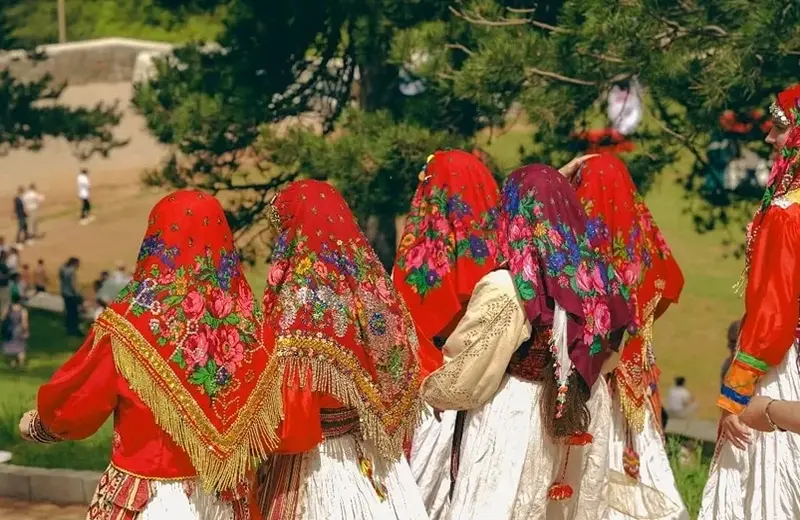
Nagaland consistently ranks among the least-visited states in India, and once you understand why, the reason has nothing to do with a lack of anything to see. It's remoteness, a permit system most travelers have never had to deal with before, and a general absence of the kind of coverage that sends people flocking to Goa or Rajasthan. What's waiting here instead is a genuinely different India: seventeen recognized tribes, villages that still organize life around community meeting houses called morungs, and one of the most distinctive cultural festivals anywhere in the country.
Seventeen tribes, one heritage village, and ten days each December when Nagaland's usual quiet gives way to drums, rice beer, and a full-scale celebration of Naga identity.
Nagaland at a Glance
| Location | Northeast India, bordering Myanmar |
| Capital | Kohima |
| Entry requirement | Inner Line Permit for Indian citizens; Protected Area Permit for foreign nationals |
| Hornbill Festival dates | December 1 to 10 annually, at Kisama Heritage Village |
| Nearest airport and railhead | Dimapur |
| Best time to visit | December for the festival; spring for Dzükou Valley's flowering season |
| Alcohol status | Officially a dry state under prohibition since 1989, with some cultural exceptions |
What Is the Hornbill Festival, Actually
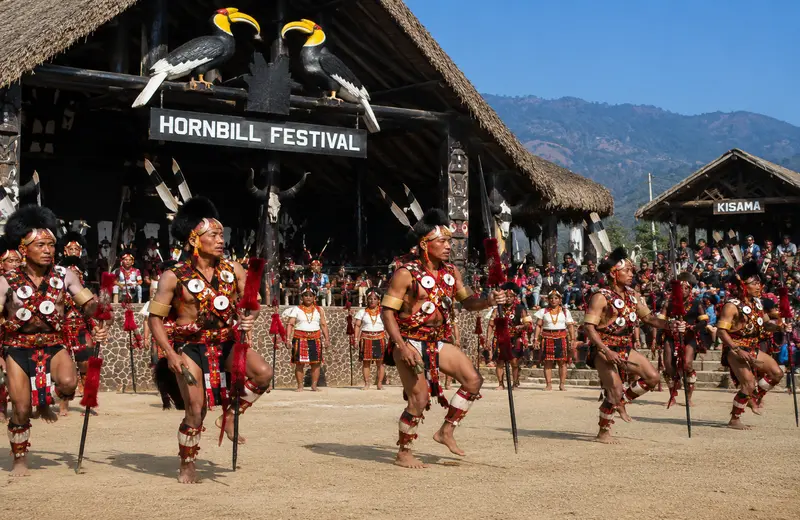
Held every year from December 1st to 10th at Kisama Heritage Village, roughly a short drive from Kohima, the Hornbill Festival brings together Nagaland's major recognized tribes for ten days of traditional dance, music, indigenous games, craft displays, and food. It's often called the "Festival of Festivals," a nod to the fact that it consolidates dozens of individual tribal harvest and cultural celebrations that would otherwise happen separately across the state throughout the year, into a single accessible event.
The festival was first organized in the year 2000, initially a smaller, government-backed initiative that has since grown into a genuine collaboration between tribal councils, artists, and local communities, and it's now one of India's most significant cultural tourism events. Each tribe maintains its own morung, a traditional community structure, within the Kisama grounds, and visitors can walk between them to see distinct dance styles, dress, and customs side by side rather than as a single generalized "tribal culture" presentation.
Entry to the festival grounds during the day is free. The evening Hornbill International Rock Contest, a genuinely popular addition to the traditional programming, requires a separate paid entry pass.
The first three days of the festival tend to carry the most energy and the largest crowds, since most performances are concentrated early on, while the middle stretch of the festival is noticeably quieter and better suited to photography and unhurried conversations with performers.
The Inner Line Permit: What You Actually Need
This is the detail that trips up more first-time visitors than anything else about planning a Nagaland trip, so it's worth reading carefully.
Indian citizens who are not native to Nagaland need an Inner Line Permit to enter the state. It's applied for online through the official Nagaland ILP portal, or in person at Nagaland House offices in Delhi, Kolkata, or Guwahati, and requires a valid government ID such as an Aadhaar card, voter ID, passport, or driving license, along with two passport-sized photographs. The fee runs around ₹200 for a standard permit, and processing typically takes anywhere from same-day at an office to 24 to 48 hours online.
Foreign nationals generally need a Protected Area Permit and may also be required to register with the nearest local police station shortly after arrival. Given how specific and occasionally shifting these requirements can be, it's worth confirming the exact current process directly through official channels or a registered Nagaland tour operator well ahead of travel dates, rather than relying on outdated guidance.
Apply for your permit at least two weeks before travel, particularly if you're planning around the Hornbill Festival, when processing volumes spike and last-minute applications risk delays that can genuinely disrupt a trip.
This kind of permit system isn't unique to Nagaland within the Northeast. If you're building a broader regional trip, both How to Reach Ziro Valley, Arunachal Pradesh and Cheapest Way to Reach Leh Ladakh cover other Indian border regions with comparable permit requirements, worth reading if this kind of restricted-zone travel is new territory for you.
Best Time to Visit Nagaland
December is the obvious answer if the Hornbill Festival itself is the draw, and it doubles as a genuinely comfortable time to visit Kohima and the surrounding hills, with cool, crisp weather that suits the walking and outdoor festival grounds well. Dimapur, at a lower elevation, stays noticeably milder than Kohima during this period.
Beyond festival season, spring brings its own strong case for a visit, particularly for travelers interested in Dzükou Valley, which blooms with its namesake seasonal lilies and turns a vivid green that photographs dramatically differently from its winter appearance. Monsoon months bring heavier rain and more difficult trekking conditions across the state's hill terrain, so they're generally better avoided unless flexibility isn't a concern.
How to Reach Nagaland
Dimapur serves as Nagaland's practical gateway, functioning as both the state's commercial hub and its main transport link to the rest of India. Dimapur Airport connects with direct flights to Kolkata, Guwahati, Delhi, and other major cities, and Dimapur Railway Station offers rail connections to Guwahati and Kolkata for travelers who prefer overland options or want to save on airfare.
From Dimapur, Kohima sits roughly 74 kilometers away, reachable by taxi or shared vehicle in about three hours along winding hill roads. Most Hornbill Festival visitors follow this exact route: fly or take the train into Dimapur, then continue by road to Kohima as a base for the festival and surrounding sights.
A Simple Itinerary
Three to four days covers the Hornbill Festival itself properly, allowing time to actually see multiple tribal morungs rather than rushing the grounds in a single overwhelmed afternoon, plus a day trip out to Khonoma or the Kohima War Cemetery.
Five to seven days opens up a more complete circuit, adding Dzükou Valley for travelers up for a genuine trek, and pushing further out toward Mon and Longwa for a deeper look at Konyak tribal culture, though this stretch requires considerably more road time given Nagaland's mountainous terrain.
Ten days or more suits travelers who want to move at a genuinely unhurried pace through multiple districts, combining the festival with village homestays, longer treks, and the kind of unstructured time that lets a trip through Nagaland's more remote areas actually breathe rather than feel like a checklist.
Kohima: War Cemetery, Cathedral & the Capital
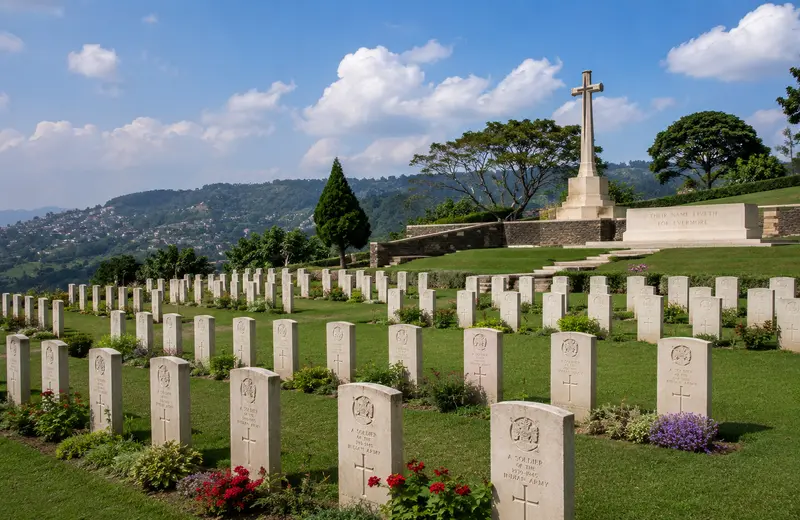
Kohima War Cemetery, perched on Garrison Hill overlooking the town, honors the roughly 1,400 Allied soldiers who died during the 1944 Battle of Kohima, a pivotal World War II engagement in the Burma campaign sometimes described as a turning point against Japanese advances into India. Maintained by the Commonwealth War Graves Commission, the cemetery's rows of white markers set against green hillside lawns make it one of the more solemn and genuinely moving stops in the state, regardless of your prior familiarity with the battle's history.
A short distance away, Kohima Cathedral blends Gothic and Naga architectural elements, with stained glass windows that catch the light well in late afternoon, and it's a quiet counterpoint to the busier festival grounds if you need a break from crowds. For travelers with a broader interest in contemplative or historically significant sites, Best Spiritual Retreats in India for a Peaceful Getaway rounds out other destinations with a similar tone.
Khonoma: A Village That Fought Off the British Twice
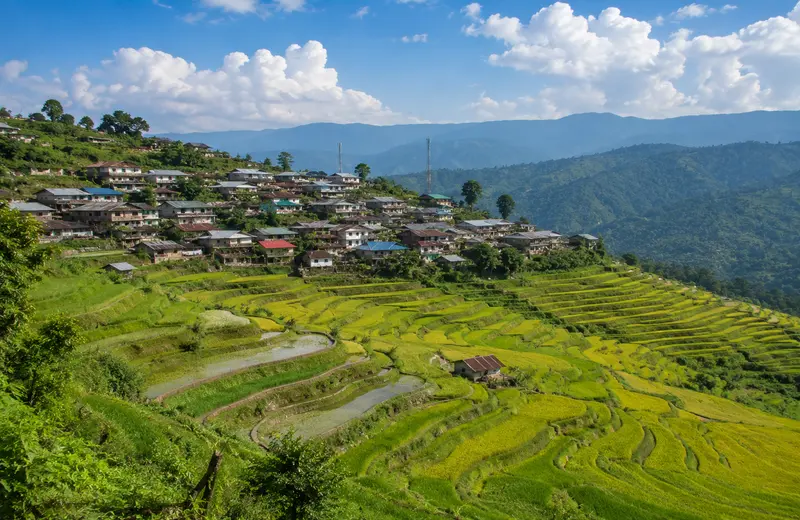
About 20 kilometers west of Kohima, Khonoma is widely cited as India's first officially recognized green village, a designation earned through community-led conservation efforts that began in the early 1990s, when village elders banned hunting and logging specifically to protect the endangered Blyth's tragopan pheasant and the surrounding forest. The Angami Naga community here has a long-documented history of fierce resistance, having repelled British forces on multiple occasions in the 19th century, including a notable 1879 conflict that cost dozens of Naga lives and left small forts and memorial tombstones scattered through the village that remain visible today.
Walking Khonoma's terraced paddy fields and stone alleyways, staying in a local homestay rather than a hotel, gives a genuinely different sense of Naga village life than the festival grounds alone can offer. It also serves as a practical base for reaching Dzükou Valley, since the trailhead sits a short drive away.
Dzükou Valley: The Trek
Dzükou Valley, accessible by trek primarily from Jakhama village, draws hikers with its rolling meadows, seasonal wildflower blooms, and a landscape that feels genuinely distinct from the forested hills surrounding it. The valley's namesake lilies bloom in a relatively narrow seasonal window, generally through the warmer months, so travelers specifically chasing that bloom should time a visit outside the December festival period.
The trek itself is a legitimate physical undertaking rather than a casual walk, and proper footwear and a realistic sense of your own fitness matter here. Given how close this sits to prime Naga wildlife habitat, Top 5 National Park In Assam And Their Location is worth a look if this kind of Northeast nature circuit appeals to you beyond Nagaland alone.
Longwa & Mon: Deep Into Konyak Country
Further north, the town of Mon serves as the gateway to Konyak Naga territory, historically known, along with the broader Konyak tribe, for a headhunting tradition that's now firmly a matter of history and cultural memory rather than practice, preserved today mainly through the tattoos and stories of the community's oldest surviving members. Longwa village, a short distance from Mon, holds the region's most talked-about curiosity: the Angh's house, home to the village's traditional chief, built directly across the India-Myanmar international border, splitting the structure between two countries in a way that's become something of a local point of pride.
Reaching Mon and Longwa requires considerably more road time than a Kohima-based trip, and it's genuinely worth building an extra buffer day into any itinerary that includes this stretch, given the hill terrain and the distance involved.
Naga Food & What to Actually Eat
Naga cuisine leans heavily into smoked and fermented flavors that are distinct from almost anywhere else in India. Pork, often smoked, shows up in the majority of traditional dishes, frequently paired with bamboo shoot, a fermented ingredient that adds a genuinely sharp, sour note most first-time visitors haven't encountered before. Rice, along with noodle and momo-style dishes reflecting the region's proximity to Southeast Asia and Tibet, forms the staple base of most meals.
Bhut jolokia, once recognized as one of the world's hottest chili peppers, originates from this region and appears in various preparations, worth approaching with genuine caution if spice tolerance isn't something you're confident about. Zutho, a traditional rice beer, holds real cultural significance at gatherings and festivals, and it's commonly offered as a gesture of hospitality even in a state that otherwise maintains formal alcohol prohibition.
Budget Breakdown
Nagaland runs moderately priced for Indian travel standards, with accommodation ranging from simple homestays in villages like Khonoma to more organized hotels in Kohima and Dimapur. Hornbill Festival season pushes prices up across the board, particularly for accommodation in and around Kohima, given how concentrated demand becomes during those ten days. Budget-tier festival packages built around shared transport and guesthouse stays exist and suit solo travelers and students well, while private vehicle hire for reaching more remote areas like Mon and Longwa adds meaningfully to overall costs given the distances and road conditions involved.
None of these figures hold steady for long, particularly around festival dates, so treat any specific number as a planning reference rather than a fixed guarantee. For a sense of what a genuinely tight overall Indian trip budget looks like, How to Travel in India for 5 Days Under Rs.10,000 – Real Budget Breakdown is a useful reference, though a Hornbill Festival trip will likely run higher given the seasonal demand and permit costs involved.
Travel Tips
Carry physical copies of your Inner Line Permit, since it gets checked at multiple points along the road, and connectivity in Nagaland's hill terrain is unreliable enough that a phone screenshot alone isn't a safe backup. Pack proper layers for December evenings in Kohima, which run genuinely cold despite the state's tropical latitude, given the elevation.
Cash matters considerably outside Kohima's main commercial areas, since smaller villages and homestays don't reliably run card machines. Remember that Nagaland has operated under formal alcohol prohibition since 1989; while rice beer appears at cultural gatherings and some informal availability exists, don't expect the kind of open commercial alcohol access common elsewhere in India, and approach the topic with basic cultural sensitivity rather than assumption. A handful of well-chosen apps make navigating unfamiliar hill terrain with patchy signal considerably easier, and Top Travel Apps in India Every Traveler Must Have is worth checking before you go.
If you're extending the trip further into the Northeast, Dawki River in Meghalaya and Jorhat & Majuli, Assam: Tea Gardens and the World's Largest River Island both fit naturally into a broader regional circuit, given their relative proximity and the shared logistics of Northeast India travel.
Capturing Nagaland in Photos
The Hornbill Festival itself is the easiest place to come away with strong images, given the sheer density of traditional dress, dance, and craft concentrated in one location, though asking permission before photographing individuals up close remains basic courtesy rather than an optional nicety. Midday light at Kisama tends to be harsh and flat, so early morning and late afternoon sessions, when performances are still running, generally produce noticeably better results than the crowded midday peak.
Kohima War Cemetery photographs with a quieter, more solemn intent than the festival grounds, and the site's hillside position works well for wide shots that include the surrounding valley alongside the rows of markers. Out in Khonoma and Dzükou Valley, early morning mist rolling through the terraced fields and meadows offers a genuinely different visual register from the festival's color and motion, worth planning a dedicated early start around if landscape work interests you as much as the cultural side of the trip.
Who Should Visit
Nagaland suits travelers genuinely curious about India's tribal cultures rather than a generalized, packaged version of them, along with photographers, history enthusiasts drawn to the Kohima War Cemetery's WWII significance, and anyone specifically planning around the Hornbill Festival's unmatched concentration of tribal performance and craft in one place. For solo travelers specifically, Solo Travel in India for Beginners: Safest Destinations & Honest Tips is worth reading beforehand, since Nagaland's permit system and remote logistics work differently than a typical solo city trip. It's a more demanding destination for travelers uncomfortable with mountain road transfers, permit paperwork, or genuinely rural accommodation standards outside the main towns, and those factors are worth weighing honestly before committing several days to the more remote stretches like Mon and Longwa.
The Bottom Line
Nagaland rewards travelers who take the planning seriously, starting with the Inner Line Permit and extending to a realistic itinerary that doesn't try to compress the whole state into three rushed days. Time your trip around the Hornbill Festival if the cultural concentration is the draw, build in Khonoma and Dzükou Valley if you want a slower, greener counterpoint to the festival crowds, and treat the road time to Mon and Longwa as part of the experience rather than an inconvenience. Sort the permit out at least two weeks ahead, and what's waiting on the other side is one of the more genuinely distinct trips available anywhere in India.