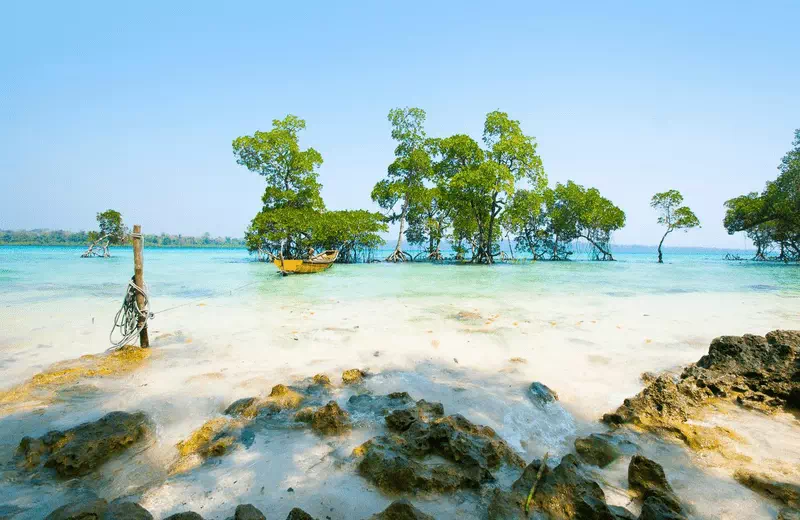
Jorhat calls itself the tea capital of the world, and the surrounding districts back that up with something like 135 working gardens stretching across Upper Assam. But the real reason travelers are starting to notice this corner of the country isn't the tea. It's a short ferry ride away, across a stretch of the Brahmaputra so wide the far bank disappears into haze: Majuli, the largest river island on earth, and one that is measurably, documentedly disappearing.
This guide covers both halves of the trip properly: Jorhat's tea estates and colonial history, and Majuli's monasteries, mask-makers, and the erosion crisis that gives a visit here a strange, quiet urgency.
Here's the shape of a Jorhat-Majuli trip at a glance.
| What to Know | Details |
|---|---|
| Best time to visit | October to March |
| Nearest airport | Jorhat Airport (Rowriah), about 7 km from town |
| Nearest major hub | Guwahati, roughly 300–307 km west |
| Getting to Majuli | Ferry from Nimati Ghat, about 14–20 km from Jorhat town |
| Minimum time needed | 3 days; 1 in Jorhat, 2 on Majuli |
| Signature experience | Sunrise ferry crossing to Majuli, followed by cycling between satras |

Best Time to Visit Jorhat and Majuli
October through March is the reliable window here, bringing dry weather, comfortable daytime temperatures, and calmer conditions on the Brahmaputra itself, which matters more than it might elsewhere given that a ferry crossing is unavoidable. This period also coincides with peak birdwatching season on Majuli's wetlands, when migratory species including bar-headed geese and the globally threatened greater adjutant stork gather on the island's exposed sandbanks.
Monsoon season, roughly June through September, floods much of Majuli's lower ground and makes ferry schedules genuinely unpredictable, sometimes cancelling crossings outright when the river turns rough. Some travelers deliberately visit during this window anyway, drawn by the raw, dramatic version of the river, but it demands flexibility that a tighter itinerary can't always accommodate.
November specifically brings Raas Mahotsav, or Raas Purnima, a major festival across Majuli's satras built around the life of Krishna, featuring the Bhaona theatrical performances the island is known for. Timing a trip around this festival, if the dates align, adds a cultural layer that an ordinary visit doesn't offer.
How to Reach Jorhat
Jorhat Airport, also called Rowriah Airport, sits about 7 kilometres from the town centre and connects to Guwahati and several other cities across eastern and northeastern India, along with a handful of weekly flights from Kolkata. Guwahati's Lokpriya Gopinath Bordoloi International Airport, roughly 300 to 320 kilometres away, is the nearest international gateway and a common connection point for travelers arriving from outside the region.
By train, Jorhat Town railway station handles most rail traffic, connected to Guwahati and onward to the rest of India's network, though journey times from major cities like Delhi or Kolkata stretch into a day or more. By road, Jorhat sits roughly 300 to 307 kilometres from Guwahati, a drive of around seven hours, with ASTC state buses and private overnight services running the route regularly.
For travelers building a longer Northeast circuit rather than a standalone Assam trip, Jorhat pairs naturally with destinations further into the hills. This guide to reaching Ziro Valley in Arunachal Pradesh and this piece on Meghalaya's Dawki River both cover onward legs of a broader Northeast India itinerary, since all three states share overlapping transit hubs and a similar October-to-March travel window.
Jorhat's Tea Gardens and Colonial Heritage
Tea is not a sideshow in Jorhat, it's the reason the town exists in its current form. The Tocklai Tea Research Institute here, founded in the early 1900s, is the world's oldest dedicated tea research centre and still shapes cultivation practices used across Assam today. Cinnamora Tea Estate, considered the first tea garden planted in Assam, and Thengal Manor, a heritage bungalow built in 1880 that once housed a tea estate family, both give visitors a sense of the industry's colonial-era roots alongside its present-day operations. Several estates, including Borahi Tea Estate, offer informal walks through the rows with tea tasting included, usually requiring nothing more than asking at the gate or arranging through a local homestay.
Beyond the gardens themselves, Jorhat carries a handful of oddly specific colonial-era distinctions: the Jorhat Gymkhana Club, founded in 1876, is among the oldest golf courses in Asia, and the town's cricket stadium is the oldest in Assam. Dhekiakhowa Bornamghar, a centuries-old prayer hall, is said to house the oldest continuously burning oil lamp in the world, a claim locals repeat with evident pride regardless of how it holds up to scrutiny.
Getting to Majuli: The Ferry Crossing
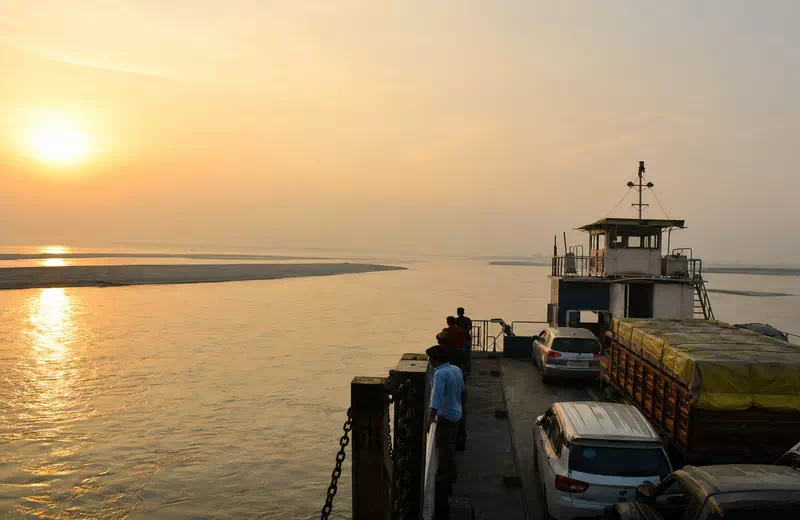
Nimati Ghat, about 14 to 20 kilometres from Jorhat town depending on the exact starting point, is where the ferry to Majuli departs, with services generally running from early morning until mid-afternoon. The crossing itself takes roughly one hour heading to the island, though the return trip against the current can run longer. Fares are modest and the ferries carry both passengers and vehicles, filling up quickly during weekends and festival periods, so arriving 30 to 45 minutes before departure during peak season is worth the buffer.
Ferry timings shift with river conditions and are not always accurately reflected in older online listings. Confirming the schedule the evening before, either through a hotel or directly at Nimati Ghat, avoids arriving to a cancelled or rescheduled crossing.
Once on Majuli, the island has no significant road network to speak of beyond a single main route and a web of unmarked cycle paths connecting its villages. Cycle rentals, available near the Kamalabari landing point where most ferries dock and most guesthouses cluster, are the standard way to get around, and the flat terrain makes the island genuinely pleasant to explore this way rather than by any motorized alternative.
Majuli's Satras and Vaishnavite Culture
Majuli's cultural weight comes almost entirely from its satras, monastic institutions founded in the 15th and 16th centuries by the saint-reformer Srimanta Sankardev, who established a distinctive, monotheistic form of Vaishnavism known as Eka Sharana Dharma. Of the roughly 65 satras originally built on the island, only around 22 remain active today, the rest lost to relocation or the river itself over the centuries.
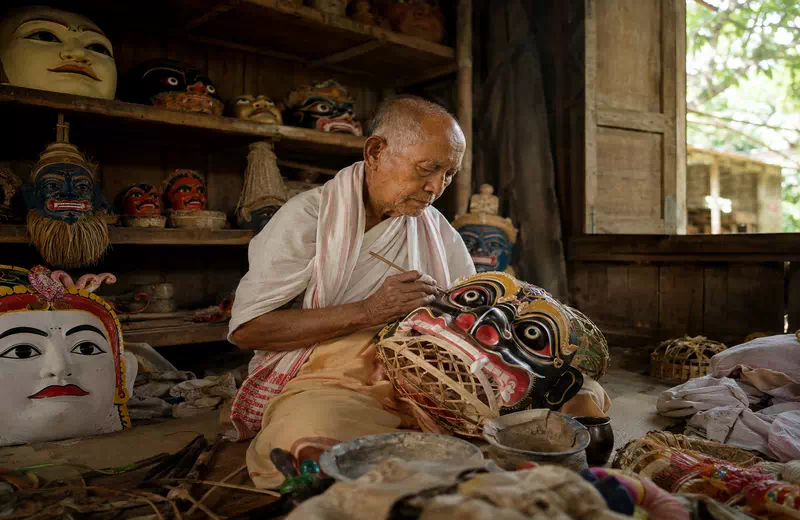
Kamalabari Satra, a short walk from the main ferry landing, is one of the oldest and functions as a genuine centre for classical Assamese art, literature, and Sattriya dance rather than a museum piece. Auniati Satra, in the island's southern reaches, holds an extensive collection of manuscripts, ceremonial artifacts, and traditional jewellery, and remains one of the most visited on the island. Natun Samaguri Satra is where Majuli's famous mask-making tradition survives, with craftsmen still producing the elaborate bamboo, cloth, and clay masks used in Bhaona religious theatre, a process that can take weeks to months depending on the mask's complexity.
These are living institutions with resident monks practising daily disciplines, not preserved relics, and visitors are generally welcome to observe rituals and craft demonstrations respectfully rather than treat the satras purely as photo stops.
Majuli's Disappearing Landscape
Majuli's size is genuinely difficult to state with a single confident number, and that ambiguity is itself part of the story. Historical estimates put the island at roughly 1,250 to 1,300 square kilometres in the late 1700s and early 1900s. Depending on which survey and measurement year a source cites, present-day estimates range anywhere from around 350 to nearly 900 square kilometres, a spread wide enough that it reflects both genuine measurement difficulty and the sheer pace of ongoing erosion rather than sloppy reporting.
What isn't in dispute is the trend: the Brahmaputra has been eating into Majuli's banks for over a century, accelerated by upstream embankments built to protect other towns from flooding, which redirect the river's force onto the island instead. More than 35 villages have been lost since the early 1990s, entire satras have relocated after their original grounds were claimed by the water, and some scientific estimates suggest the island loses several square kilometres of land annually. Government-funded protection efforts, including embankments and afforestation programs, have been underway for decades with limited success against a river this powerful.
None of this should discourage a visit; if anything, it's part of why Majuli feels different from most Indian destinations. It's a place where residents openly discuss the possibility that their villages, and the satras that have anchored Assamese culture for five centuries, may not exist in their current form within a generation or two.
Wildlife Nearby: Kaziranga and the Gibbon Sanctuary
Kaziranga National Park, a UNESCO World Heritage Site roughly 90 to 100 kilometres from Jorhat, holds the largest population of the greater one-horned rhinoceros anywhere in the world and is a natural add-on for travelers with an extra day or two. Closer to town, Hoollongapar Gibbon Sanctuary protects India's only ape species, the hoolock gibbon, alongside several other primates and a substantial bird population, within a compact forest reachable as an easy half-day trip from Jorhat itself. This roundup of Assam's national parks covers Kaziranga and several other reserves across the state in more detail for travelers planning to extend the wildlife portion of their trip.
Food to Try in Jorhat and Majuli
Assamese food built around rice, fish, and minimal spicing dominates the plate here, a genuinely different register from most Indian regional cuisines. Masor tenga, a tangy fish curry typically soured with tomato or a local citrus, is close to the everyday staple. Khar, a distinctive alkaline dish made using filtered ash from banana peel or bark, appears in various forms and is considered one of the more uniquely Assamese preparations a visitor is likely to encounter. Pitha, rice-based sweets in numerous forms, and alu pitika, a simple mashed potato dish seasoned with mustard oil and green chilli, round out a typical meal.
On Majuli specifically, meals tend toward simple local eateries near Kamalabari and Garamur rather than anything resembling a restaurant scene, and apong, a traditional rice beer brewed by the Mishing community, is worth trying at least once as part of an evening spent talking with hosts rather than sightseeing.
Budget and Practical Costs
This remains one of India's more affordable regions for travelers, particularly once past the initial flight or train into Guwahati or Jorhat. Ferry fares to Majuli are inexpensive, cycle rentals on the island cost little for a full day, and local eateries charge a fraction of what similar meals run in more commercialized tourist circuits.
Accommodation ranges from basic guesthouses and homestays clustered around Kamalabari, some run by Mishing families in traditional bamboo stilt houses, to slightly more comfortable options in Jorhat town and a small number of heritage tea-estate bungalows that lean upmarket. ATMs on Majuli are limited and not always reliable, so carrying enough cash from Jorhat before crossing over is standard practice rather than an inconvenience worth working around.
Travel Tips
Cash matters more here than in most of India; digital payments haven't spread evenly across Majuli's smaller establishments, and the island's handful of ATMs can't always be relied on to work. Confirming ferry timings the day before travel, rather than trusting a schedule found online, avoids the single most common frustration travelers report here.
Respect matters particularly at the satras, which function as active religious institutions rather than tourist attractions, so modest dress and a quiet, observational approach go further than treating a visit as a photo opportunity. Comfortable footwear suits the cycling-heavy way most people explore Majuli, and light layers work well given the temperature swings between winter mornings and warmer afternoons across the region.
A Simple Three-Day Plan
Day one covers Jorhat itself: a tea estate tour and tasting in the morning, Thengal Manor and the Tocklai Tea Research Institute in the early afternoon, and an evening in town before an early night ahead of the ferry crossing. Day two starts before dawn with the taxi to Nimati Ghat and the sunrise crossing to Majuli, followed by cycling to Kamalabari Satra and Auniati Satra, with lunch at a simple local restaurant near Garamur and an afternoon spent at the mask-making satra if timing allows.
Day three on Majuli can lean toward birdwatching at one of the southern wetlands if visiting in winter, or a slower morning cycling through Garamur's paddy fields and bamboo groves before the return ferry to Jorhat in the afternoon. Travelers with an extra day or two should consider extending toward Kaziranga, roughly 90 to 100 kilometres away, before heading back to Guwahati.
The Bottom Line
Jorhat and Majuli reward travelers looking for something genuinely different from India's more established circuits: working tea estates instead of packaged plantation photo-ops, and a river island whose living monastic culture sits, quite literally, on borrowed time. Book ferry crossings with a buffer for schedule shifts, carry cash before heading to Majuli, and give the island at least two full days rather than treating it as a single rushed day trip from Jorhat. For travelers drawn to destinations that reward this kind of unhurried attention, this list of underrated Indian hill stations offers a similar flavour of off-the-main-circuit travel elsewhere in the country.