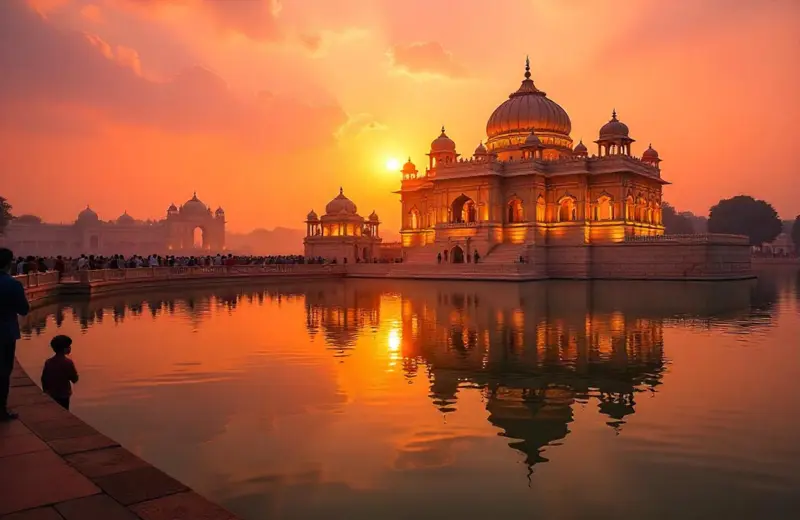
Amritsar packs an unusual emotional range into a single day. Stand at the edge of the Amrit Sarovar before sunrise and the loudest thing around is a hymn drifting across still water. Drive out to the border that same evening and you'll be in a stadium-like crowd stamping, cheering, and matching a soldier's high kick with their own. Few Indian cities move between these two registers, devotion and spectacle, as naturally as Amritsar does.
This guide covers the two anchors of an Amritsar trip properly, the Golden Temple and the Wagah Border ceremony, along with what else genuinely earns a place on the itinerary: Jallianwala Bagh, the food, and how to fit it all into two unhurried days.
Here's the shape of an Amritsar trip at a glance.
| What to Know | Details |
|---|---|
| Best time to visit | November to February, 5–20°C |
| Nearest airport | Sri Guru Ram Dass Jee International Airport (ATQ) |
| Main railway station | Amritsar Junction (ASR) |
| Wagah Border distance | About 28–30 km from the city, roughly an hour's drive |
| Minimum time needed | 2 days; 3 if adding rural Punjab sites beyond the city |
| Signature experience | Sunrise at the Golden Temple, sunset at the Wagah Border ceremony |
Best Time to Visit Amritsar
November through February is the clear favourite, with daytime temperatures generally sitting between 5 and 20°C, cool enough for long stretches of walking around the Golden Temple complex without the punishing heat that defines Punjab's summer. April brings Baisakhi, a major harvest and religious festival that adds noticeable energy to the city and the temple in particular, worth timing a visit around if the dates line up.
Summer, roughly April through June, pushes temperatures into the 35 to 45°C range, making outdoor sightseeing genuinely difficult outside the early morning and evening hours. Monsoon months bring moderate rainfall and higher humidity, which thins out crowds somewhat but adds little to the experience beyond that.
How to Reach Amritsar
Sri Guru Ram Dass Jee International Airport connects Amritsar directly to Delhi, Mumbai, Bengaluru, and several other major Indian cities, along with a handful of international routes, making it a realistic entry point for travelers coming from outside the country as well. Amritsar Junction, the city's main railway station, sits on the well-served Delhi-Punjab corridor, with frequent express and overnight trains covering the route in around six to seven hours from Delhi.
By road, Amritsar connects well to Delhi, Chandigarh, and Jammu via national highways, and once in the city, most sights, including the Golden Temple and the old quarter, are within a short taxi or auto-rickshaw ride of each other. The Wagah Border, being outside the city proper, requires a separate taxi, shared transport, or an organized tour, since it isn't served by regular city transport.
The Golden Temple: Sri Harmandir Sahib
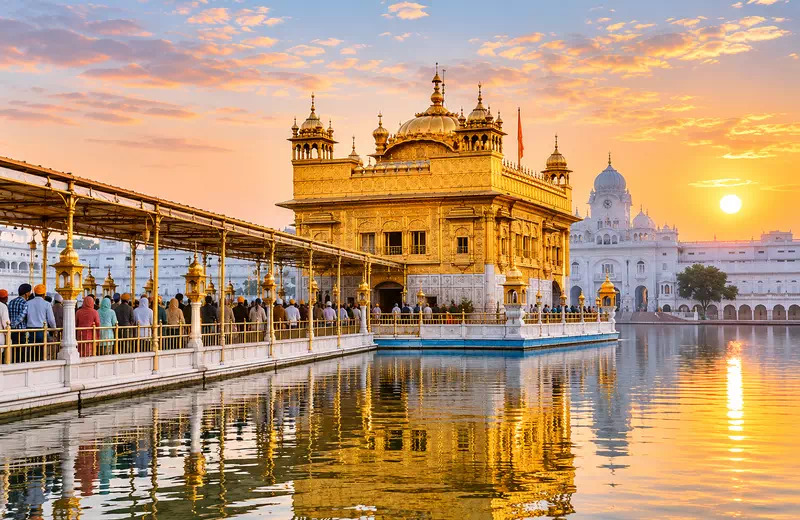
Sri Harmandir Sahib, universally known as the Golden Temple, is the holiest gurdwara in Sikhism and the reason Amritsar exists in its current form. Guru Ram Das, the fourth Sikh guru, founded the city in 1577 around a sacred tank, the Amrit Sarovar, from which Amritsar takes its name. The temple itself sits at the end of a causeway extending into the sarovar, its dome plated in gold and its base built from white marble, a combination that gives the structure its distinctive shimmer at both sunrise and after dark, when it's illuminated.
The temple complex operates around the clock, and the two ends of the day offer genuinely different experiences. Early morning, roughly 4 to 6 AM, brings a quieter, more contemplative atmosphere, with the recitation of scripture carrying across the water before the day's crowds arrive. Evening visits, once the complex is lit, show off the gold dome's reflection in the sarovar in a way daylight simply doesn't.
Head coverings are required for everyone entering the complex, and free scarves are available at the entrance for visitors who arrive without one. Photography is permitted throughout the complex and the parikrama walkway, but not inside the inner sanctum where the Guru Granth Sahib is placed.
The langar, a free community kitchen that serves a simple vegetarian meal to everyone regardless of religion, caste, or background, is central to the temple's identity and reportedly feeds tens of thousands of people daily, making it one of the largest continuously operating free kitchens anywhere. Visitors are welcome to eat here alongside pilgrims seated on the floor, and many also choose to spend some time helping in the kitchen or dining hall as a way of participating in seva, or selfless service, rather than simply observing from the sidelines.
The Wagah Border Ceremony
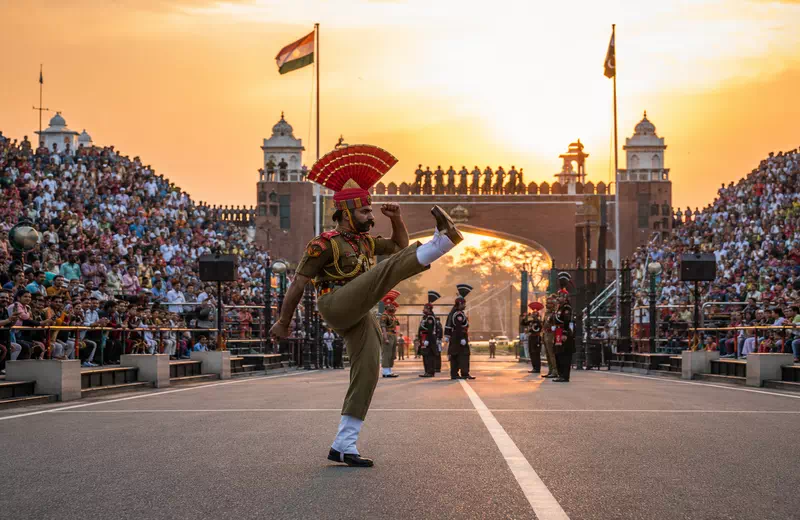
About 28 to 30 kilometres from Amritsar, roughly an hour's drive, sits the Wagah-Attari border crossing between India and Pakistan, home to a daily Beating Retreat ceremony performed jointly by India's Border Security Force and Pakistan's Rangers. The ceremony begins about an hour before sunset and runs for approximately 45 minutes, built around synchronized high-kicking marches, rapid flag lowering, and a closing of the border gates that draws a genuinely large, energetic crowd on both sides.
Seating is arranged in a stadium-like setup facing the border gate, with sections closer to the road giving a more intense, up-close view of the marching and choreography, while higher stands offer a broader view of the full ceremony and the crowd itself. Arriving with enough buffer time before the ceremony starts is worth it, since security checks and the walk from the parking area to the seating add time that's easy to underestimate on a first visit.
Jallianwala Bagh and the Partition Museum
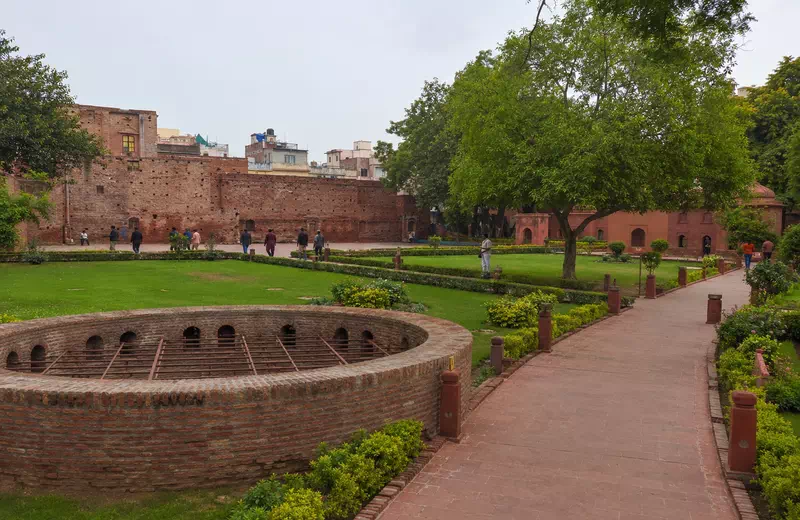
A short walk from the Golden Temple, Jallianwala Bagh is a memorial garden marking the site of the 1919 massacre, when British troops fired on an unarmed gathering, an event that remains one of the defining moments of India's independence movement. Bullet marks are still visible on some of the surrounding walls, and the site is generally visited in a quieter, more reflective register than the rest of the city's itinerary.
The Partition Museum, housed in Amritsar's Town Hall, covers a different but related chapter: the personal stories and displacement caused by the 1947 partition of India and Pakistan, told largely through firsthand accounts and preserved objects rather than a purely academic timeline. Both sites fit naturally into a morning that starts at the Golden Temple, given their proximity to it and to each other.
Beyond the Big Two: Durgiana Temple and Rural Punjab
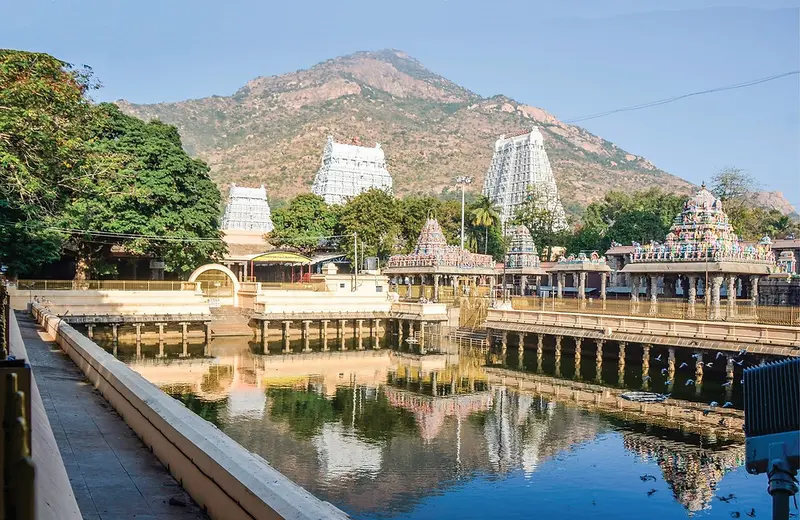
Durgiana Temple, also known as Lakshmi Narayan Temple, is a Hindu temple built in an architectural style clearly influenced by the Golden Temple, complete with its own causeway and tank, and offers a quieter, less crowded alternative for visitors interested in Amritsar's broader religious landscape beyond Sikhism specifically.
Travelers with an extra half day might also consider Sarai Amanat Khan, a Mughal-era caravan sarai about 40 kilometres from the city known for its glazed tile work and Arabic inscriptions, or Pul Kanjari, a small bridge with its own layered history spanning Maharaja Ranjit Singh's court and the India-Pakistan wars of 1965 and 1971, located close to the Wagah Border itself. Neither is essential on a first visit, but both reward travelers who've already covered the main sights and want a quieter, more historical detour.
For those extending the trip further into the region, Punjab's own protected areas are worth a look; this guide to Punjab's national parks covers a different side of the state entirely. Travelers building a longer North India circuit might also consider the drive onward to Jammu, common among visitors combining Amritsar with the pilgrimage to Vaishno Devi, covered in this guide to reaching Vaishno Devi from Jammu, or toward the hills via Chandigarh, detailed in this route guide to Manali via the Chandigarh road.
Food to Try in Amritsar
Amritsar's food reputation is built on richness rather than subtlety, and it largely earns it. Amritsari kulcha, a stuffed, buttery flatbread typically filled with spiced potato or paneer, is close to the city's signature dish, usually served with chole and a side of raw onion. Amritsari fish, battered and fried with a distinct spice mix, and the city's version of butter chicken, which several local establishments claim as the dish's true origin point, round out the heavier end of the menu. Lassi, thick enough in the more traditional spots to require a spoon, is the standard way to finish a meal here rather than dessert in the conventional sense.
Hall Bazaar, close to the Golden Temple, concentrates much of this food scene into walkable lanes, and long-running dhabas near the old city, some sitting wall to wall with decades of local rivalry between them, remain the preferred spots for a proper meal over anything more polished aimed at tourists.
Photography at the Golden Temple
The temple's reflection in the Amrit Sarovar is the shot most visitors come away with, and it works best either just after sunrise, when the water is calmest and the light is soft, or after dark once the complex is fully illuminated, when the gold dome and its reflection both glow against the night sky. Midday light tends to flatten the gold's shimmer and brings the heaviest crowds into the frame, so it's generally the least rewarding window for photography despite being when most visitors happen to pass through.
Tripods and large camera setups are generally discouraged inside the complex given the volume of pilgrims moving through at most hours, and a simple handheld camera or phone works well enough given how reflective and well-lit the temple already is. As mentioned earlier, photography inside the inner sanctum itself is not permitted under any circumstances, a rule enforced consistently regardless of how empty the space might look at a given moment.
Shopping in Amritsar
Hall Bazaar and the lanes immediately around the Golden Temple double as Amritsar's main shopping district, and a few local crafts are worth seeking out specifically rather than settling for generic souvenirs. Phulkari embroidery, a traditional Punjabi needlework technique using bright floral patterns on fabric, appears on dupattas, stoles, and home textiles throughout the old city, with quality and pricing varying considerably between shops, so comparing a few before buying is worth the extra ten minutes. Punjabi juttis, the region's traditional embroidered footwear, are sold in numerous small shops around the bazaar, ranging from simple everyday pairs to heavily embellished versions intended for weddings and festivals.
Amritsar is also a reasonable place to pick up dry fruits and pickles, both staples of Punjabi kitchens, along with packaged versions of the city's spice blends for anyone looking to recreate the food at home. None of this requires seeking out a specific store; wandering Hall Bazaar with some time to spare generally surfaces most of it on its own.
Budget and Practical Costs
Amritsar remains reasonably affordable relative to India's larger metro cities, particularly for food and local transport. The Golden Temple itself has no entry fee, and the langar meal is free, funded entirely through donations and volunteer labour, which makes a substantial part of a day here cost nothing beyond getting to the temple.
Transport to the Wagah Border typically runs through a shared taxi, tuk-tuk, or an organized half-day tour, with costs varying depending on group size and whether the vehicle is air-conditioned; splitting the cost with other travelers, common at hostels, brings the per-person price down considerably. Accommodation spans a wide range, from simple hostels close to the Golden Temple to more comfortable hotels in the newer parts of the city, with prices rising during Baisakhi and other major festival periods.
Travel Tips and Etiquette
Modesty and head coverings are non-negotiable at the Golden Temple, and shoes must be removed before entering the complex, with a free shoe-storage facility available at the entrance. Photography restrictions inside the inner sanctum are taken seriously and enforced by volunteers, so it's worth checking before assuming a shot is allowed.
For the Wagah Border, arriving well before the stated start time matters more than it might seem, given security screening and the walk from parking to the seating area; organizing transport through accommodation, particularly for solo travelers, is often the simplest way to split costs with others heading the same direction. Two to three days comfortably covers Amritsar's main sights without feeling rushed, and pairing a morning at Jallianwala Bagh and the Partition Museum with the temple, followed by an afternoon departure for Wagah, is a realistic single-day combination if time is genuinely tight.
A Simple Two-Day Plan
Day one starts early with sunrise at the Golden Temple, followed by breakfast and a walk through Jallianwala Bagh and the Partition Museum, both a short distance away. The afternoon works well for Hall Bazaar's food lanes and a slower second visit to the temple complex, before returning in the evening to see it illuminated after dark.
Day two is built around the Wagah Border: a late-morning visit to Durgiana Temple, lunch at one of the city's well-known dhabas, and departure for Wagah with enough buffer time before the ceremony begins in the late afternoon. Travelers with a third day should consider Sarai Amanat Khan or Pul Kanjari for a quieter, more historical close to the trip.
The Bottom Line
Amritsar doesn't ask visitors to choose between its two headline experiences, the stillness of the Golden Temple at sunrise and the noise of Wagah at sunset; the contrast between them is, in many ways, the actual point of visiting. Book accommodation early during Baisakhi and other festival windows, arrive at both the temple and the border with enough time to avoid rushing, and don't skip Jallianwala Bagh simply because it sits at the quieter end of the itinerary.