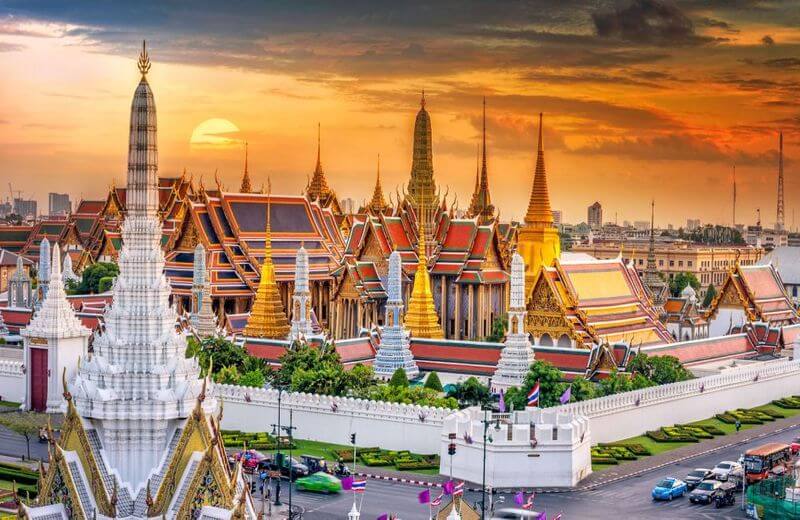
If you only visit one temple in Bangkok, it is going to be this one. Wat Phra Kaew, the Temple of the Emerald Buddha, sits inside the walls of the Grand Palace and holds the most revered Buddha image in the country: a small jade figure raised high above a golden altar that the King himself dresses for each season. The catch is that plenty of first-timers turn up in shorts and get turned away at the gate, or fall for a tout outside who swears the place is shut. This guide covers the parts that actually trip people up: what a ticket costs and covers, the dress code that is enforced without exception, how to get there, and what is worth your time once you are inside.
Bangkok's most sacred temple, a jade Buddha guarded by giants and gold, with a dress code strict enough to send you home for a wardrobe change if you arrive unprepared.
| At a glance | Details |
|---|---|
| What it is | Thailand's most sacred temple, inside the Grand Palace |
| Also known as | Temple of the Emerald Buddha (Wat Phra Sri Rattana Satsadaram) |
| Where | Phra Nakhon, Bangkok's old quarter, by the Chao Phraya River |
| Ticket | One Grand Palace ticket covers the temple and the palace grounds |
| Hours | Opens early morning, closes mid-afternoon (confirm on the day) |
| Time needed | Around two to three hours for the whole complex |
| Dress code | Strict and enforced; shoulders and knees must be covered |
| Easy to combine with | Wat Pho next door and Wat Arun across the river |
What Wat Phra Kaew Actually Is
A common mix-up: the Grand Palace and Wat Phra Kaew are not two separate tickets or two separate visits. The temple sits in the northern part of the palace grounds, and you walk through it first, before reaching the palace halls. Wat Phra Kaew is the royal chapel, which is why, unusually, no monks live here. It was built in 1782 when King Rama I moved the capital to Bangkok, and it has been the spiritual heart of the kingdom ever since, used for royal ceremonies that still happen today.
The reason for all the reverence sits in the main ordination hall: the Emerald Buddha. Despite the name, it is carved from a single block of jade, the green stone giving it the title. It is smaller than most people expect, roughly 66 centimetres tall, seated in meditation in the northern Lanna style and thought to date to around the 15th century. It rests high on a gilded throne, and no one is permitted to touch it except the King.
Three times a year, at the change of season, the King personally changes the Emerald Buddha's robe, swapping between a gold-and-diamond costume, a solid gold one, and a gilded monk's robe. The ritual is believed to bring the country good fortune, and only the monarch may perform it.
Tickets and Opening Hours
There is a single entrance fee for foreign visitors that covers the whole site: Wat Phra Kaew, the Grand Palace grounds, and a textile museum on the premises. Thai nationals enter free with ID, and small children under a certain height go free as well. You buy it at the official counter inside the gate, where there is no bargaining and no need for a middleman.
The complex opens in the morning and stops selling tickets in the mid-afternoon, so this is a morning outing, not an afternoon one. Ticket prices and hours do get adjusted from time to time, so check the current figures before you go rather than trusting an old number.
Arrive right at opening. The grounds bake under the midday sun and fill with tour groups by mid-morning, so the first hour is cooler, quieter, and far better for photos. Give yourself two to three hours, and remember the route runs one way with no backtracking.
The Dress Code: Don't Get Turned Away
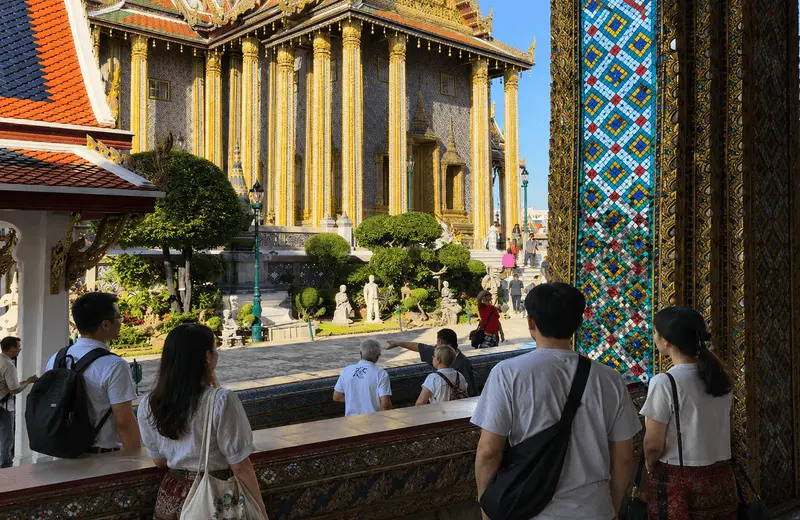
This is where the most visitors come unstuck, so it is worth being clear. The dress code is strict and the staff enforce it; if you are not covered up, you do not get in. Shoulders must be covered, which rules out sleeveless tops, vests, and tank tops. Legs must be covered below the knee, which rules out shorts, short skirts, ripped jeans, and tight leggings worn as trousers. See-through fabric will not pass either, and closed shoes are the safer choice.
If you turn up in the wrong thing, there is a stall near the entrance that rents sarongs and cover-ups for a refundable deposit, but it means queuing in the heat when you could have just dressed for it. The rules apply equally to men and women. Treating a sacred site with respect is part of visiting it well, and the same spirit runs through travelling responsibly in Thailand more broadly.
How to Reach Wat Phra Kaew
The temple sits in Bangkok's old royal quarter, away from the Skytrain network, so getting there takes a little planning. The most pleasant route is by river. Take the BTS to Saphan Taksin, walk down to the pier, and catch a Chao Phraya Express Boat upriver to Tha Chang Pier (N9); from there the Grand Palace entrance is about a five-minute walk. The nearby Tha Tien pier (N8) is the one for Wat Pho if you are doing both.
The MRT Blue Line now reaches the area too, with Sanam Chai station a walk of roughly ten to fifteen minutes from the gate. A metered taxi or a Grab works if you would rather go door to door, in which case "Grand Palace" or "Wat Phra Kaew" is all the driver needs, though Bangkok traffic can turn a short hop into a long one. Tuk-tuks will offer to take you, but they overcharge for the distance and are the usual source of the scam below.
The "Temple Is Closed Today" Scam
You will almost certainly meet someone, often near the gate or stepping out of a tuk-tuk, who tells you Wat Phra Kaew or the Grand Palace is closed today for a ceremony, a holiday, or prayers, and offers to take you somewhere better instead.
This is a long-running scam. The Grand Palace is almost never closed to visitors, and the "helpful" stranger is steering you toward gem shops or tour operators that pay them a commission. Ignore anyone on the street who tells you it is shut, walk to the official entrance, and check for yourself.
What to See Inside
The Emerald Buddha is the centrepiece, sitting in the ordination hall with its doors and windows inlaid with mother-of-pearl. You can step inside to sit before it, but photography is not allowed in that hall, so this is a moment to put the phone away. Shoes come off before you enter, and you sit with your feet pointed away from the image.
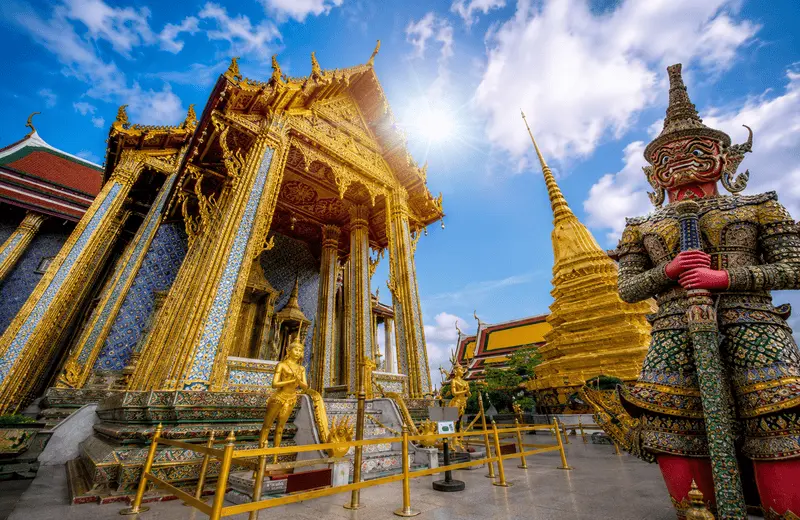
Outside the hall, the rest of the complex rewards a slow wander. The golden Phra Si Rattana Chedi catches the light from across the grounds. The library hall and the Royal Pantheon show off the glass-mosaic, gilded style that defines the place, and there is a detailed scale model of Angkor Wat that Rama IV had built. Running along the inner cloister walls is a painted mural cycle telling the Ramakien, the Thai version of the Ramayana, in panel after panel.
Guarding the gates are the yaksha, towering demon figures from that same epic, and they are among the most photographed things on the grounds. If temple architecture is your thing, it is worth seeing how this style compares across the country's most striking temples.
Combine It With Wat Pho and Wat Arun
Few people make a special trip out to this corner of Bangkok just once, so it pays to cluster the sights. Wat Pho, home to the enormous reclining Buddha and a famous massage school, is about a ten-minute walk south, and it makes the obvious pairing, though seeing two grand temples back to back can be a lot in one go. A meal or a cold drink in between helps.
From the Tha Tien pier you can hop a cross-river ferry to Wat Arun, the Temple of Dawn, whose tiled spire is at its best in late-afternoon light, which conveniently is when you will be done with the Grand Palace. If you have more days in the country, the ruined temples of the old capital at Ayutthaya make a strong day trip, and closer to the city the craft island of Ko Kret is an easy escape from the temple circuit.
A Few Last Tips
Carry water and expect to sweat; there is little shade on the grounds and the stone reflects the heat. Cash is handy for the sarong deposit and for snacks afterward, though the ticket counter does take cards. Keep your voice down and your behaviour calm inside the temple itself, since worshippers come here to pray and it remains an active religious site, not just a photo stop. And do not let the crowds rush you past the murals; they are the part most people walk straight by and the part that stays with you.
Wrap-Up
Wat Phra Kaew is the one Bangkok sight that earns its hype, sacred to Thais and dense with detail for everyone else, from the small jade Buddha in its seasonal robes to the giants at the gates and the Ramakien stretching down the walls. Dress for it, arrive at opening, ignore anyone who says it is closed, and give yourself a couple of unhurried hours. The simplest plan: get to Tha Chang pier or Sanam Chai station early, walk to the official gate, and start your Bangkok temple day right here.