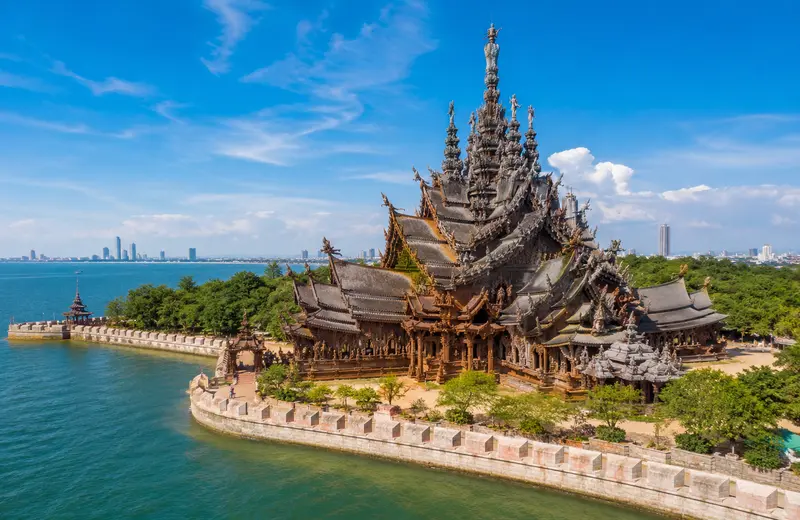
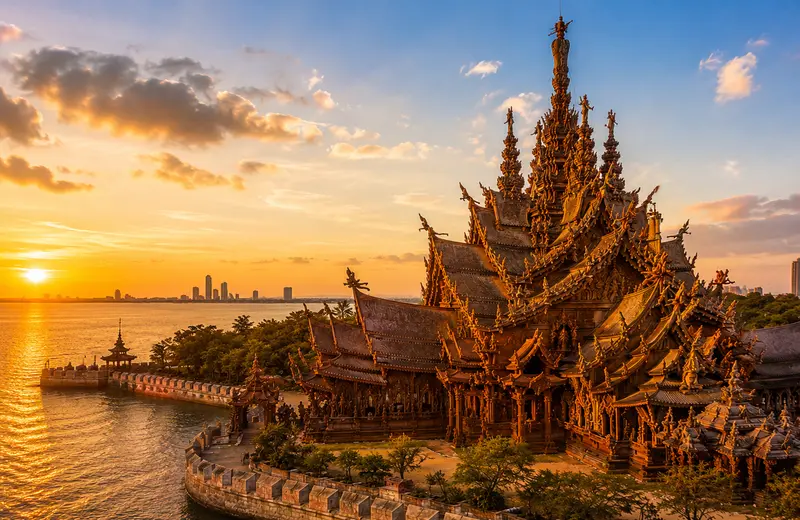
A 105-metre tower of carved teak stands on a spit of land in north Pattaya, half in the sea breeze and half still under the chisel. This is the Sanctuary of Truth, and the first thing most people get wrong about it is the word temple. It looks like one. It feels like one, right down to the hush that falls over you at the doorway. But there are no resident monks and no daily prayers here. What fills it instead is wood: thousands of hand-cut figures of gods, guardians and celestial dancers, fitted together without a single metal nail.
Locals call it Prasat Sut Ja-Tum. Foreign visitors just call it the wooden temple, and once you see it rising against the Gulf of Thailand you understand why the name sticks. It is one of the few big-ticket sights in Pattaya that has nothing to do with beaches or nightlife, which is exactly why it draws such a different crowd. If you want to know what to expect, what a ticket really buys you, how to get there, and how to dress so you actually get let in, here is the full picture.
A giant hand-carved wooden monument in Pattaya where the building itself is the message, and it is still being built.
At a Glance
| Detail | Information |
|---|---|
| Location | Naklua, North Pattaya, Chonburi (right on the sea) |
| What it is | Hand-carved all-wood museum and monument (not an active temple) |
| Built from | Teak and other hardwoods, joined with wooden pegs, no nails |
| Height | About 105 metres at the central spire |
| Started | 1981, still a work in progress |
| Nearest airports | U-Tapao (UTP) south of Pattaya; Suvarnabhumi (BKK) about 2 hours away |
| Best time to visit | November to February (cool, dry); early morning or late afternoon for light |
| Typical hours | Around 8:00 am to 6:00 pm daily (confirm on the official site) |
| Entry (approx.) | Roughly 500 THB adult / 250 THB child at last check (fees change, verify officially) |
| Dress code | Shoulders and knees covered; sarong rental available on site |
| Time needed | 1.5 to 3 hours |
What Exactly Is the Sanctuary of Truth?
Start with the man behind it. A Thai businessman named Lek Viriyaphan commissioned the structure in 1981 as a physical argument for an idea: that human civilisation has always been held up by philosophy, religion and a search for truth. Rather than write that idea down, he had it carved. Every wall, column, doorway and ceiling panel became a surface for craftsmen to fill with meaning.
The building follows the lines of the old temples of Ayutthaya, Thailand's former capital, so if you have spent time among those ruins the silhouette will feel familiar. If Ayutthaya is on your list, the Buddha head cradled in tree roots at Wat Mahathat is the single most photographed relic of that era and pairs neatly with a visit here.
The same vision produced two other giants you may have heard of: the Ancient City open-air museum and the Erawan Museum, both near Bangkok. The Sanctuary of Truth is the wildest of the three, mostly because of one stubborn rule its builders set for themselves. No modern machinery shortcuts. No steel. No nails. The whole thing is held together by traditional joinery, the same tongue-and-groove and peg techniques Thai carpenters used centuries ago.
The "no nails" claim is not marketing. Walk close to any joint and you can see the wooden pegs doing the work that bolts and screws do in an ordinary building. That single decision is the reason the place has taken more than four decades and still is not finished.
The Four Wings and What the Carvings Mean
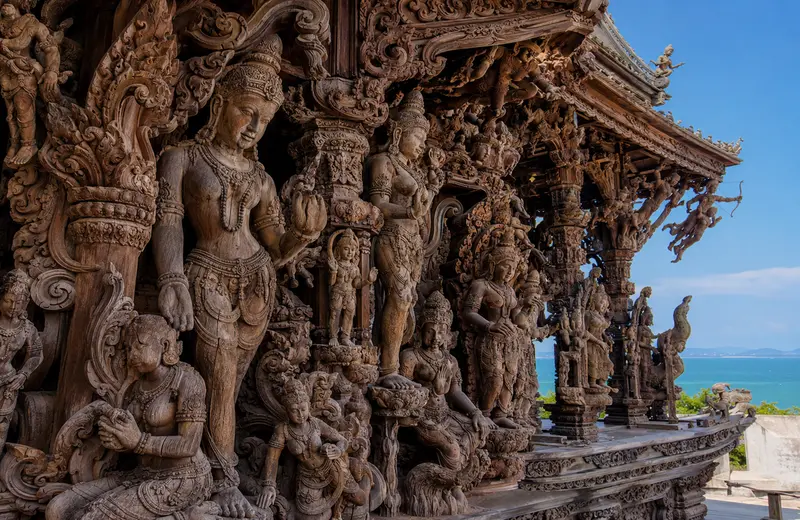
The floor plan is a cross, with four wings reaching out from a soaring central hall. Each wing leans into one of the cultural and religious traditions that shaped this part of Asia: Thai, Khmer, Chinese and Indian. You will see Hindu deities beside Buddhist figures, Chinese motifs beside Angkor-style forms, all sharing the same roof without argument.
Look up as you move through the halls and a pattern starts to appear. The carvings return again and again to what the builders described as the seven forces a human being cannot exist without: heaven, earth, father, mother, sun, moon and stars. On the rooftop sits a four-faced Brahma and, elsewhere, the elephant-headed Ganesha. Inside, the central column climbs the full height of the structure, and the domed wooden ceiling lets daylight pour down onto the podium in a way photographs never quite capture.
Do not rush the exterior. Walk the full perimeter slowly before you head inside. Figures hide inside other figures, and the longer you look the more the surface seems to move. This layered detail is what separates the Sanctuary from the painted, gilded temples elsewhere in the country. For a sense of that contrast, browse the range in this guide to Thailand's most stunning temples, then notice how different bare carved wood feels from gold leaf and mirrored glass.
Best Time to Visit
Pattaya runs on a tropical calendar with three moods. The cool, dry stretch from November to February is the comfortable one, with daytime highs around 30°C, low humidity and very little rain. That is peak season, so prices climb and the site gets busier, but the weather earns it.
March to May turns hot and sticky, with afternoons pushing past 33°C. The Sanctuary offers little shade on its open platforms, so a midday visit in April can be punishing. June to October brings the monsoon, though the rain usually arrives in short, heavy bursts rather than all-day drizzle, and this is when hotels are cheapest and the grounds quietest.
Whatever month you pick, the time of day matters more than most people expect. Aim for the first hour after opening or the last two hours before closing. Not only is the heat softer, the low sun turns the teak a warm amber that the harsh noon light flattens out completely.
For photos, late afternoon is the winner. From roughly 4:00 pm the wood glows against the sea, and if you time it right you can carry that light straight into sunset from the viewpoint near the entrance.
How to Reach the Sanctuary of Truth
The site sits at 206/2 Moo 5, Soi Naklua 12, in the Naklua district at the northern end of Pattaya, right where the land meets the water.
From central Pattaya. It is a short hop, about 15 to 20 minutes by road from the Walking Street area. A metered taxi or a booked car is the simplest option and usually runs a couple of hundred baht. The cheap-and-local way is a songthaew, the shared pickup-truck "baht bus" that runs up Naklua Road. You get off near Soi 12 and walk the last stretch to the entrance, sometimes grabbing a motorbike taxi for the final bit.
From Bangkok. Pattaya is roughly a two-hour drive south, around 150 km via the motorway. Frequent buses and minivans leave from Bangkok's main terminals, and there are direct coach services from Suvarnabhumi Airport if you want to skip the city entirely. Once in Pattaya you still cover the last leg to Naklua as above.
By air. The closest airport is U-Tapao (Rayong–Pattaya International), a short drive south of the city and handy if your route allows it. Most international travellers land at Bangkok's Suvarnabhumi instead and transfer down by road.
If you are combining the temple with beach time, Sai Kaew Beach near Pattaya makes an easy add-on for the other half of your day.
Tickets, Timings and the Dress Code Nobody Tells You About
Here is the practical stuff, with one honest caveat: prices, hours and show times shift, so treat the numbers below as a guide and confirm the current details on the official Sanctuary of Truth website (sanctuaryoftruth.com) before you go.
At the last widely reported rates, entry sat at around 500 THB for adults and 250 THB for children, with small children admitted free. A ticket covers a walk through the complex and a guided element, and booking online in advance often shaves a little off the price while helping you skip the queue in peak season. The grounds generally open around 8:00 am and close by 6:00 pm, with the last entry an hour or so before closing.
Two things trip visitors up. The first is the dress code. This is treated as a place of respect, which means covered shoulders and knees. If you turn up in a vest or short skirt you will be handed a wrap-around sarong to rent, usually against a small refundable deposit, so there is no need to panic if you forget. The second is the hard hat.
Because the Sanctuary is an active construction site, you may be given a helmet to wear inside. It is not a gimmick. Real carpenters are working overhead and around you, which is part of what makes the visit feel alive rather than staged.
Things to Do Beyond the Building
The ticket gets you the monument, but the grounds around it are set up like a small cultural park. A traditional Thai dance and cultural show runs a couple of times a day on an open stage near the water, and it is included, so it is worth timing your visit to catch one.
Down by the shore you can take a ride on a wooden boat that loops around the promontory, which gives you the postcard angle of the whole structure floating above the sea. Elephant rides, horseback riding and a horse-drawn carriage circuit are offered on site too, along with Thai costume rental if you want dressed-up photos in front of the carvings. None of these are compulsory, and plenty of visitors are happy simply walking the perimeter with a camera.
Give the place at least ninety minutes. Two to three hours is more realistic if you take the show, walk slowly and stop to watch the woodcarvers. That last part is the quiet highlight for many people. You can stand a metre from an artisan shaping a figure that will eventually join the walls, work that can take a single craftsperson years to finish.
Photography: Getting the Shot
This is one of the more rewarding subjects in Pattaya for anyone who likes taking pictures, and the reasons are specific rather than vague.
The building sits on a promontory with water on three sides, so a step back onto the sea-facing platform gives you the full 105-metre spire in one frame. A wide-angle lens or an ultra-wide phone mode handles the height best, and portrait orientation suits the tall spires. For the carvings, get in close. Macro-style shots of a single face, a pair of hands or a dancer's pose reveal detail that vanishes in the big wide views. The interior runs darker than you expect, so a phone that copes with low light, or a small bump in ISO, saves the indoor frames.
Light is everything here. Midday sun bleaches the wood pale and drops harsh shadows across the carvings. The warm hour before sunset does the opposite, and it is the difference between a snapshot and something you will actually print.
Is It Worth It? A Straight Answer
If your idea of Pattaya is beaches, bars and boat trips, this is the one cultural stop that tends to convert even the sceptics. It is not a quick roadside shrine. It is a genuinely unusual building, made by hand, still growing, and unlike anything else on the Thai coast. Travellers who arrive expecting to tick a box often stay far longer than planned.
It will not suit everyone. The open platforms are hot in the middle of the day, some walkways are uneven, and the entry price is higher than the small temples you can wander into for free elsewhere. Weigh that against what you are actually paying for, which is decades of craftsmanship you can watch continuing in real time.
Thailand rewards travellers who mix the loud with the quiet. Balance a day like this with time in the country's temple heartland through guides to Wat Arun, the riverside Temple of Dawn in Bangkok, the Emerald Buddha at Wat Phra Kaew, and the clifftop stairs of Tiger Cave Temple in Krabi, and the Sanctuary of Truth starts to make even more sense as one voice in a much bigger conversation.
Final Word
The Sanctuary of Truth is best understood not as a finished attraction but as a living one. It was never meant to be "done," and the sight of craftsmen still carving decades on is the whole point rather than a delay. Go in the cool season if you can, arrive early or stay for the late light, cover your shoulders and knees, and give yourself real time to look. Your next step is simple: check the current hours and ticket price on the official site, then block out an afternoon so you are not rushing past the details that make this place worth the trip.