Some buildings you photograph. Wat Arun Temple Bangkok is one you stop and stare at. Glide down the Chao Phraya River, glance toward the west bank, and there it is — a porcelain-studded spire catching the light, looking like something poured out of a dream rather than built by hand. Known the world over as the Temple of Dawn, this is one of those rare landmarks that lives up to every photo you've ever seen of it. And the good news? Visiting is simpler and cheaper than most travellers expect. This guide walks you through the tickets, the timings, exactly how to reach it, what to wear, and where to stand for that perfect shot.
Everything you actually need to visit the Temple of Dawn — entry fee, opening hours, ferry routes, dress code and the best free viewpoints — in one honest, no-fluff guide.
Wat Arun at a Glance
Short on time? Here's the quick version before the full breakdown below.
| Detail | What to know |
|---|---|
| Location | West (Thonburi) bank of the Chao Phraya River, Bangkok Yai, Bangkok 10600 |
| Also known as | The Temple of Dawn |
| Opening hours | Daily, roughly 8:00 AM – 6:00 PM (last entry usually ~5:30 PM) |
| Entrance fee | Around 200 THB for foreign visitors |
| Time needed | About 1 to 2 hours |
| Easiest way to reach | Cross-river ferry from Tha Tien Pier |
| Dress code | Shoulders and knees covered |
| Best for | Architecture lovers, photographers, first-time Bangkok visitors |
Heads up: Fees, opening hours and ferry fares can change. Treat the numbers in this guide as a planning reference and confirm the latest details through official temple or Bangkok tourism channels before you go.
What Makes Wat Arun So Special
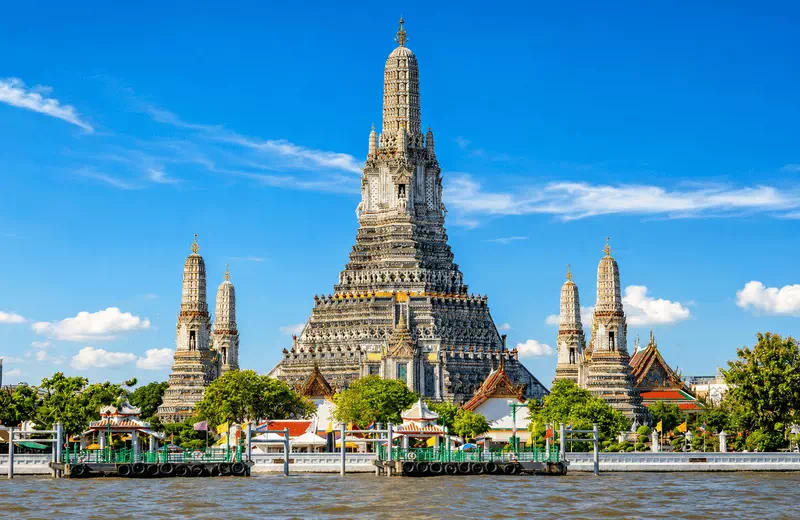
Most Thai temples glitter with gold. Wat Arun does something different — it shimmers. Walk up close to the central tower and you'll see why: the entire surface is encrusted with thousands of pieces of broken Chinese porcelain and seashells, pressed into the stucco to form flowers, mythical figures and intricate patterns. Much of that porcelain arrived as ballast on Chinese trading ships and was repurposed into one of the most distinctive temple surfaces anywhere in Thailand.
The star of the show is the central prang — a tall, corn-cob-shaped spire built in the Khmer architectural style. It rises roughly 70 metres above the river (sources quote anywhere from about 60 up to 82 metres depending on what's being measured), which makes it the largest prang of its kind in the country. Four smaller satellite prangs surround it, and together they're designed to represent Mount Meru, the sacred mountain at the centre of the universe in Hindu-Buddhist cosmology.
The name itself is poetry. "Arun" comes from Aruna, the Hindu god of dawn, and on a clear morning the rising sun hits the porcelain and turns the whole tower from pale white to soft gold. That's the Temple of Dawn earning its name in real time.
Wat Arun Entrance Fee: How Much Does It Cost?
The Wat Arun entrance fee for foreign visitors is around 200 THB (roughly US$5–6, or about ₹500). Small children typically enter free. The fee covers the temple grounds and the terraces of the central prang where you can climb up for river views.
A few practical things worth knowing:
- The ticket counter is cash only, so carry small Thai baht. Don't rely on a card here.
- The temple's outer riverside areas can often be enjoyed without paying, but the main prang complex is behind the ticket gate.
- You generally don't need to book online in advance — tickets are sold at the entrance, and queues move quickly outside peak hours.
Money tip: The entry price has changed in recent years (it was lower not long ago). Always check the current rate at the gate or via official sources rather than assuming an old figure you saw online.
Wat Arun Opening Hours and Timings
Wat Arun is open daily, roughly from 8:00 AM to 6:00 PM, with the last entry usually around 5:30 PM. The temple grounds themselves are compact, so most visitors comfortably explore everything in one to two hours.
If you want the calmest experience, aim for right at opening — the porcelain looks beautiful in soft morning light, the crowds haven't arrived, and Bangkok's heat hasn't peaked. The window between roughly 11:00 AM and 2:00 PM is the hottest and busiest, with tour groups at their thickest.
Timing matters: Opening hours and the last-entry cut-off can shift for ceremonies, holidays or maintenance. Double-check before a tight-schedule visit so you're not turned away at the gate.
How to Reach Wat Arun
This is where Wat Arun surprises people. It looks far across the river on a map, but it's genuinely one of the easier Bangkok attractions to reach — and the journey itself is half the fun.
By cross-river ferry (the classic route)
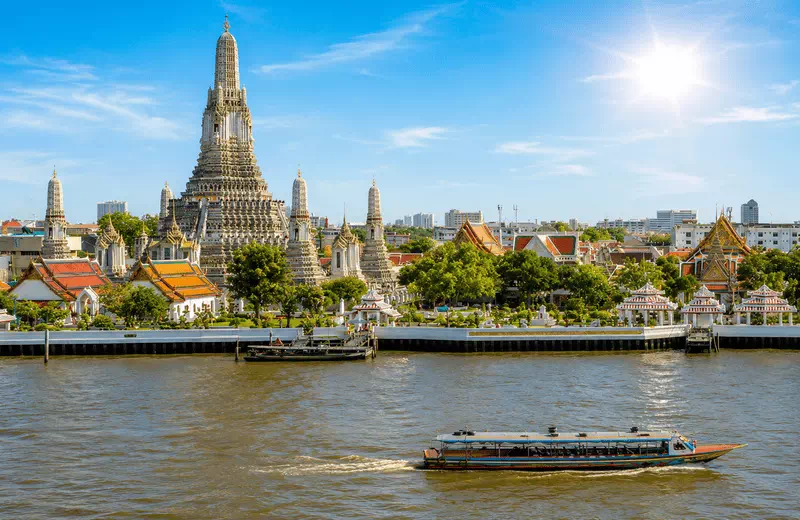
The temple sits on the Thonburi (west) bank of the Chao Phraya River, directly opposite the historic old town. The simplest approach is to get yourself to Tha Tien Pier (N8) — the pier right next to Wat Pho — and hop on the cross-river ferry to Wat Arun Pier. The crossing takes only 3 to 5 minutes, boats run frequently, and the fare is just a few baht (around 5 THB). You pay at the dock before boarding. That first head-on view of the spires from the water is the best approach view in the city.
By MRT (subway)
Take the MRT Blue Line to Sanam Chai station, then walk about 10 minutes to Tha Tien Pier and take the cross-river ferry across. If you'd rather stay on the same side as the temple, Itsaraphap station on the Blue Line is on the Thonburi bank, roughly a kilometre's walk from the temple.
By BTS Skytrain plus boat
If you're coming from the Sukhumvit or Silom side of the city, ride the BTS to Saphan Taksin station (Exit 2), walk to Sathorn (Central) Pier, and board a Chao Phraya Express Boat (orange flag) or the Chao Phraya Tourist Boat (blue flag) heading upriver. Get off at Tha Tien, then take the short cross-river ferry. The express boat is cheaper; the tourist boat costs a little more but is more relaxed and tourist-friendly.
By taxi or Grab
A metered taxi or a Grab ride drops you near the Thonburi-side entrance and is the most comfortable option for families, groups or anyone travelling in the midday heat. If you're piecing together a wider trip and want to lean on public transport, this rundown on getting around Thailand without renting a car is a handy companion.
Best Time to Visit Wat Arun
There's no single "best" time — it depends on what you're after.
- Early morning (around 8:00–9:00 AM): Fewest crowds, cooler air, soft light on the porcelain. The most peaceful way to see the temple up close.
- Late afternoon to sunset: The light turns golden and the tower glows. Beautiful, but this is also the busiest stretch, so expect company.
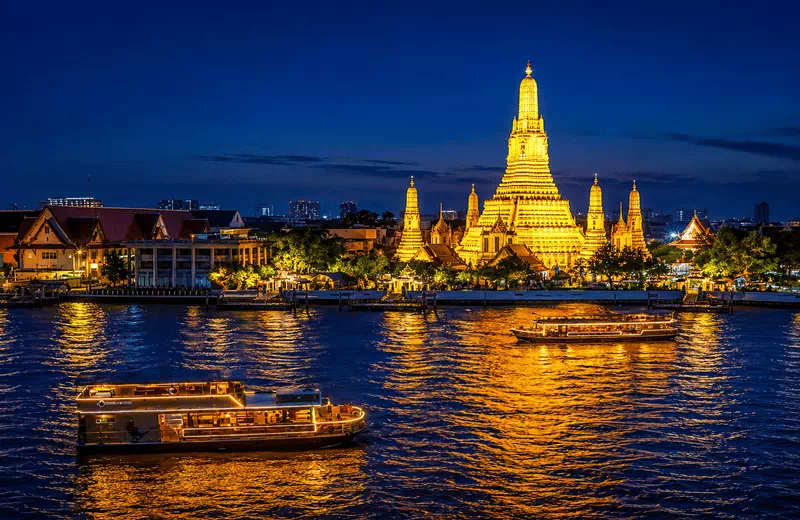
- After dark: You can't enter the temple at night, but it's floodlit after sunset and looks spectacular from across the river. More on that in the viewpoints section below.
Season-wise, Bangkok runs hot year-round. The cool, dry months (roughly November to February) are the most comfortable for wandering the open temple grounds, but they're also peak tourist season. March to May is genuinely hot — early starts become essential. The green season (around May to October) brings short, sharp showers and noticeably thinner crowds, and the wet porcelain actually takes on a lovely sheen.
Dress Code and Temple Etiquette
Wat Arun is an active place of worship, and the dress code is enforced — not just suggested.
- Cover your shoulders and your knees. That means no sleeveless tops, no short shorts and no mini skirts for anyone.
- If you turn up in the wrong outfit, don't panic. Sarongs and cover-ups are available to borrow or rent at the entrance for a small fee (or sometimes free), so you won't be turned away.
- Remove your shoes before stepping inside the ordination hall and certain interior buildings.
- Keep your voice low, avoid pointing your feet at Buddha images, and be discreet with photography around people praying.
Many visitors also rent traditional Thai costumes from shops near the temple for photos — a fun touch, though prices vary by shop, so ask before committing. Showing this kind of respect is part of being a thoughtful guest; if you care about doing it well across your whole trip, these tips on travelling responsibly in Thailand are worth a read.
Pack smart: Bring a light scarf or shawl in your day bag. It doubles as instant temple-appropriate cover and saves you the rental queue at the gate.
What to See Inside Wat Arun
Once you're through the gate, give yourself time to explore beyond the obvious.
The central prang. You can climb the lower terraces via a set of steep, narrow staircases for elevated views over the Chao Phraya and the old-town skyline across the water. Note that the very top is usually off-limits and the steps are properly steep — take your time and use the handrails.
The guardian giants. Flanking the entrance to the prang are two towering Yaksha (giant) statues. For visitors familiar with the Ramayana, there's a lovely connection here — these guardians are drawn from the Ramakien, Thailand's version of the epic, so the characters may feel surprisingly familiar.
The ordination hall (ubosot). Quieter and often overlooked, the main ordination hall houses a graceful Buddha image and walls decorated with detailed murals. It's a cool, calm contrast to the busy prang.
The riverside terrace and gardens. The flat promenade along the water is one of the calmest corners of the complex and frames the opposite bank beautifully.
If Wat Arun lights a spark for temple-hopping, you'll find plenty more on the list of most stunning temples in Thailand to slot into your itinerary.
The Best Wat Arun View Point: Where to Stand for the Perfect Photo
Here's the honest truth most guides bury: the best view of Wat Arun is not from inside it. Because the temple sits on the west bank, the most jaw-dropping, unobstructed shots — especially at golden hour and after dark — are taken from the east bank, looking across the river.
The prime Wat Arun view point zones include:
- The Tha Tien / Wat Pho waterfront, where the riverside promenade lines up directly across from the temple. Free and easy to reach.
- Riverside restaurants and rooftop bars on the east bank that are purpose-built to face the temple. You'll pay for a drink or a meal, but the view is unbeatable, particularly once the floodlights come on.
- Quiet riverside cafés and small piers in the same area, which offer the same view at a fraction of the cost — perfect if you'd rather sip a coffee than commit to a full dinner.
For sunset, get into position at least an hour early; the east bank fills up fast. For night shots, the temple is illuminated and its reflection ripples across the dark water — arguably its most magical look, and entirely free to enjoy from the opposite bank.
Photography quick tips: a low ISO keeps night shots clean, a small tripod helps with long exposures after dark, and the warm light in the 15–20 minutes before sunset is the sweet spot.
A Little History: From Ayutthaya to Icon
Wat Arun is older than Bangkok itself. Its origins reach back to the Ayutthaya era, when it was a modest local temple under a different name. Its rise to prominence came with King Taksin, who established his capital at Thonburi in 1768 after the fall of Ayutthaya — and for a time, the temple even housed the revered Emerald Buddha before that sacred image was moved across the river to the Temple of the Emerald Buddha (Wat Phra Kaew) in 1785.
The soaring prang you see today is largely the work of Kings Rama II and Rama III in the early-to-mid 19th century, with the great tower completed around 1851. Later kings refined the temple and gave it the full ceremonial name Wat Arun Ratchawararam Ratchawaramahawihan. If you're drawn to the deeper roots of Thai temple history, the haunting Wat Mahathat in Ayutthaya — famous for the Buddha head cradled in tree roots — makes a powerful companion visit to the same era this story began in.
Combine Wat Arun with Nearby Attractions
One of the best things about Wat Arun is how easily it pairs with Bangkok's other heavyweight sights, all clustered around this stretch of the river.
- Wat Pho (Temple of the Reclining Buddha): a short cross-river ferry away, easily combined with Wat Arun in a single half-day.
- The Grand Palace and Wat Phra Kaew: Bangkok's most famous complex, just across the water — plan a separate two to three hours for it.
- Riverside markets and cafés around Tha Tien and Tha Maharaj: ideal for a post-temple lunch or coffee with a view.
Got an extra day and want something more low-key? A relaxed weekend day trip from Bangkok to Ko Kret pottery village is an easy, local-feeling escape that balances out the big-ticket temples.
Final Thoughts: Is Wat Arun Worth It?
Without question. Wat Arun Temple Bangkok delivers exactly what it promises — a one-of-a-kind, porcelain-clad spire that looks different at every hour of the day, all for a modest entry fee and a charming little ferry ride. Keep the essentials in mind: it's open daily roughly 8:00 AM to 6:00 PM, costs around 200 THB to enter, asks you to cover your shoulders and knees, and is easiest reached by the cross-river ferry from Tha Tien. Time your visit for early morning calm or sunset glow, and save the east bank for that unforgettable after-dark view.
Your next step: lock in a rough plan — pick your time slot, pair it with Wat Pho or the Grand Palace, and confirm the current fee and hours through official channels before you set out. Do that, and the Temple of Dawn will be one of the easiest highlights of your entire Bangkok trip.