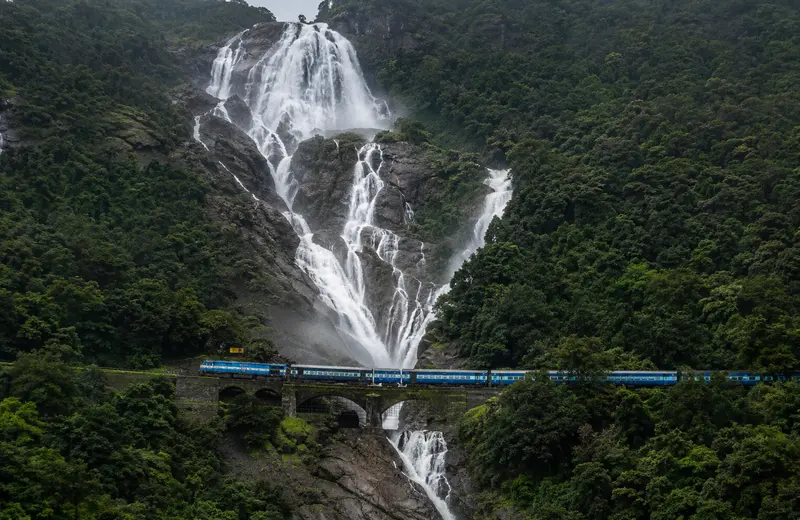
Goa sells itself on beaches and beach shacks. Then you see a photo of a four-tiered wall of white water dropping through green forest, with a train crossing a stone bridge halfway down, and you realise the state has been hiding its loudest attraction inland. That is Dudhsagar. The name means "sea of milk", and once the water is in full flow you stop arguing with the translation.
Getting there is not as simple as hailing a cab, though, and a lot of first-timers waste half a day or break a rule they did not know existed. This guide walks you through exactly how to visit Dudhsagar Falls from Goa without the common mistakes: which route is legal, what the jeep safari actually costs, when the falls look their best, and the small details that decide whether your trip feels smooth or stressful.
A practical, no-fluff guide to reaching Dudhsagar from Goa, what it costs, the right season, and the things tour brochures skip.
Quick reality check: You cannot drive your own car or bike up to the base of Dudhsagar, and you cannot legally walk the railway tracks to reach it. The only sanctioned road access is a Forest Department jeep safari from the village of Kulem (also spelled Collem). Plan around that and everything else falls into place.
At a Glance
| Detail | What to know |
|---|---|
| Location | Goa–Karnataka border, inside Bhagwan Mahaveer Sanctuary & Mollem National Park |
| Height | Around 310 metres (about 1,017 feet), four-tiered, on the Mandovi River |
| Distance from Panaji | Roughly 60 km by road to Kulem |
| Nearest airport | Dabolim (Goa) |
| Nearest railway station | Kulem (the jeep safari launch point) |
| Only legal road access | Forest Department jeep safari from Kulem |
| Best season overall | Post-monsoon, roughly October to January |
| Time needed | A full day from most Goa beach areas |
Where Is Dudhsagar, Exactly?
Dudhsagar sits right on the border between Goa and Karnataka, tucked inside the Bhagwan Mahaveer Sanctuary and Mollem National Park in the Western Ghats. The water you see is the Mandovi River early in its journey, dropping through a crescent-shaped valley before it eventually winds west to Panaji and the Arabian Sea.
It is a four-tiered fall, and at roughly 310 metres it ranks among the tallest waterfalls in India. The "milk" look comes from the sheer volume of water churning into white foam as it hits the rocks, which is why it photographs so well in the months right after the rains.
By road it is about 60 km from Panaji. The catch is that the last leg into the sanctuary is off-limits to private vehicles, so "distance from Goa" really means "distance to Kulem", where your jeep safari begins.
How to Reach Dudhsagar Falls from Goa
There are really two ways in that matter, and one popular method that will get you fined. Here is an honest look at each.
Option 1: Jeep Safari from Kulem (the standard, legal route)
This is how the overwhelming majority of visitors do it, and for good reason. You make your way to Kulem village, park at the designated lot, and join a shared Forest Department jeep. Each jeep takes up to seven people, and if you are a smaller group, the counter pairs you with others to fill the vehicle.
The jeep then bumps its way through the sanctuary for roughly 40 minutes to an hour, fording shallow streams and rattling over boulder-strewn forest track. It is genuinely off-road, so anyone with a bad back should brace for it. The jeep drops you a short walk from the base, where you get a fixed window of time before it heads back.
Two names that trip people up: The station before Kulem is called Kalem, and the spellings look almost identical. Travellers regularly get off one stop early at Kalem by mistake. Kulem is the end of the line for the local passenger train, so if you are on it, stay on until the last stop.
If you would rather not deal with logistics at all, plenty of operators sell a full-day package with hotel pickup, the jeep ticket, and usually a spice plantation lunch bundled in. That is the path of least resistance, though you pay for the convenience.
Option 2: The Kulem Trek
From Kulem you can also trek to the base on foot through the sanctuary rather than taking the jeep. It is a tougher walk through dense, humid jungle with stream crossings, graded moderate-to-hard, and because the trail runs through protected forest you need Forest Department permission and ideally a guide. During heavy monsoon spells the authorities may suspend this too. If you want effort and quiet over speed, this is the version for you.
What you should NOT do: the railway track walk
You will find old blog posts and social media reels glamorising a walk along the railway line from Castle Rock or Kulem straight to the falls. Do not do it. The Goa Forest Department and the railways have banned it, and they enforce it. Walking the tracks is treated as trespassing on active railway property, people have been detained and fined, and there have been deaths on that route over the years. The trains pass through unlit tunnels with no room to escape. No photo is worth that.
Getting to Kulem: Train, Cab, or Scooter?
Your first job is simply reaching Kulem. Here is how the options stack up from the main Goa areas.
By train. The Vasco–Kulem daily passenger train runs from Madgaon and Vasco in South Goa to Kulem, taking about an hour, and the parking lot is a two-minute walk from Kulem railway station. This is the cheapest and arguably most charming way to arrive. One honest warning from regular visitors: return trains from Kulem are scarce, so check the timetable before you commit to going both ways by rail.
By cab. A taxi gives you door-to-door comfort, especially from North Goa. The trade-off is cost, since Goa cabs are not cheap and Kulem is a long haul from the northern beaches. From the Baga–Calangute belt it is roughly an 80 km drive of about two hours, climbing through the forested hills past Ponda.
By scooter. Riding gives you freedom for the road portion, and the route through the hilly villages is lovely. But it is a long, winding ride from North Goa, and you still cannot ride into the sanctuary itself. Many people park the bike at Mollem or Kulem and switch to the jeep from there. If you want to explore the rest of Goa on two wheels around this trip, the practical side of renting and riding is covered in this guide on exploring Goa on a scooter.
For broader planning, Dudhsagar is one of the better inland breaks from the coast, and it shows up on most good lists of day trips from Goa for exactly that reason.
Best Time to Visit Dudhsagar Falls
This is the question that makes or breaks the trip, because the falls are a completely different experience depending on the month.
Post-monsoon (roughly October to January) is the sweet spot for most people. The rains have filled the river, so the falls are powerful and white, but the trails have dried enough that jeep safaris run normally and the forest is not dangerously slippery. Skies are clearer, photos are better, and access is reliable.
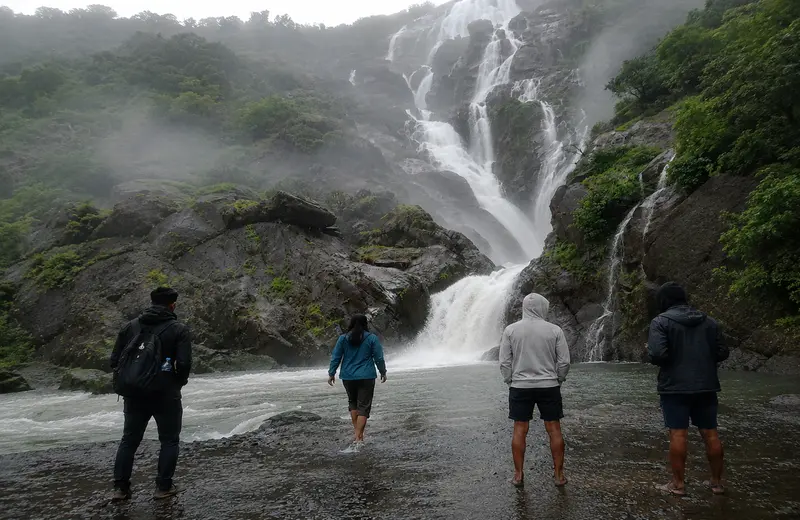
Peak monsoon (June to September) is when Dudhsagar is at its most ferocious and the surrounding forest turns electric green. The cruel twist is that this is also when access is most restricted. Authorities routinely suspend the jeep safaris during heavy rain because of swollen streams and landslide risk, and swimming is prohibited due to the strong current. If you visit now, you are often limited to the supervised forest trek, and even that can shut on short notice.
Dry season (February to May) still gives you the jeep safari and a calmer pool to relax in, but the flow drops. By late spring some visitors find parts of the cascade reduced to a trickle, and the "sea of milk" looks more like a stream. It is still a pleasant outing, just not the postcard.
Honest recommendation: If you want the falls thundering and you want to actually reach them comfortably, aim for the weeks right after the monsoon ends. You get most of the volume with full, reliable access. Monsoon visits can be magical, but treat them as a gamble and always confirm the day's status before you set out.
If your whole trip happens to land in the rainy months, the upside of a green, dramatic Goa is real, and there is a strong case for visiting Goa in the monsoon generally, as long as you keep your Dudhsagar plans flexible.
What the Jeep Safari Costs
Here is where you should keep expectations realistic, because prices shift and depend heavily on how you book.
If you go the bare-bones route and pay only the Forest Department directly at Kulem, the per-person cost for the shared jeep plus forest entry and the compulsory life jacket tends to land in a modest range. The catch with doing it raw is the queue. Tickets are usually cash-only at the counter, and on busy days people report long, frustrating waits just to buy them, sometimes a couple of hours.
A bundled day-tour package costs more but folds in hotel pickup and drop, the jeep ticket, all entry fees, life jackets, and commonly a spice plantation visit with a Goan lunch. For travellers short on time or coming from North Goa, that convenience often justifies the markup.
Because these figures change with the season, fuel prices, and the operator, do not lock in a number from any blog. Confirm the current rate directly at the Kulem Forest Department counter or with a verified operator before you book.
Money tip: Carry enough cash for the on-site counter, since card payment is unreliable there. Also clarify before paying whether camera charges, the spice plantation, and any elephant interaction are included or billed separately, because "extras" are where package quotes quietly balloon.
A Sample Day Plan
A Dudhsagar trip from the Goa beaches eats a full day, so plan it as one.
An early start is non-negotiable, partly because the drive is long and partly because the counter stops selling tickets in the early afternoon and the falls area closes by late afternoon. Tour operators typically pick up from North Goa hotels around dawn. After the drive to Kulem and the jeep ride in, you usually get somewhere around an hour at the base to take photos, soak your feet, or swim where it is permitted. From there, most organised tours roll into a spice plantation in the Ponda–Mollem area for a buffet lunch, with an optional church stop at the historic Basilica of Bom Jesus in Old Goa on the way back. You are generally returned to your hotel by early evening.
If you would rather build your own loop and stay closer, the South Goa side puts you nearer to Kulem than the northern party beaches, which shaves real time off the morning drive.
Things to See and Do Around the Falls
The waterfall is the headline, but the area rewards a little curiosity.
The base pool itself is the main draw. In the safe, calmer seasons you can wade or take a supervised dip, and life jackets are mandatory and provided. Changing rooms are available near the falls. Keep a sharp eye on your belongings, because the resident monkeys are bold and will grab food or bags; do not feed them, since they turn aggressive fast.
Close by, the lesser-visited Tambdi Surla holds one of Goa's oldest temples, a small Mahadev shrine of carved basalt sitting quietly in the forest, plus a small waterfall that needs a careful approach. The surrounding sanctuary is rich in birdlife and the occasional larger mammal, so the jeep ride doubles as a low-key wildlife drive.
If chasing cascades becomes the theme of your trip, Goa and its borders hide several more, and this round-up of waterfalls near Goa is a good next stop. For a complete change of scenery, the hill stations near Goa make an easy pairing with a Dudhsagar day.
Photography: Getting the Shot
The iconic frame is the four-tier cascade with a train crossing the stone arch bridge midway down. Trains pass at intervals and the pilot engine often honks, so keep your camera ready rather than waiting for a schedule that does not exist.
Light is best in the morning before the crowd thickens and before the spray haze builds. The whole scene is wet, so a lens cloth and a dry bag for your gear are worth more than any fancy filter. The forest approach on the jeep also offers good candid frames of streams and dense canopy, which most people forget to shoot because they are too busy holding on.
The rail journey to Dudhsagar is itself one of the prettier stretches in the country, and it features on most lists of scenic train journeys in India if you want to make the travel part of the experience.
Travel Tips Before You Go
A few practical things make the day far smoother. Wear shoes with grip rather than flip-flops, because the rocks near the base are slick and the jeep drop-off involves a short walk over uneven ground. Carry a government photo ID, since it is checked at the forest gate. Pack water, snacks, and a rain layer if there is any chance of showers, and stash valuables in something waterproof for the splashy jeep ride.
Alcohol is banned inside the wildlife sanctuary, and intoxicated visitors can be turned away at the gate. Single-use plastic is discouraged, so carry out whatever you carry in. If you are relying on your phone for navigation, payments, or train times, signal inland can be patchy; a couple of useful India travel apps downloaded for offline use before you leave the coast can save you a headache.
Safety first: Never attempt to reach the falls by walking the railway tracks, and never ignore the safety instructions about swimming during high flow. The current after rain is far stronger than it looks, and the railway route is both illegal and genuinely deadly.
Where to Stay and What to Eat
Most people do Dudhsagar as a day trip and sleep on the coast, which is sensible given how a full Goa holiday is usually beach-anchored. If you want short morning drives to Kulem, basing yourself in South Goa makes sense; if your trip is mostly about the northern beaches, you will simply start earlier.
Eating near the falls is basic, with small joints around Kulem station serving simple meals and snacks. The better food experience is the spice plantation lunch that many tours include, where you get a traditional Goan buffet in a forest setting. For the rest of your trip, Goa's real value lies in its casual coastal eating, and a guide to the best budget beach shacks in Goa will stretch your food budget far better than anything inland.
Final Word
Dudhsagar is the rare inland sight that can hold its own against Goa's beaches, but it asks for a bit of planning in return. Remember the three things that actually matter: the only legal road access is the Kulem jeep safari, the post-monsoon months give you the best balance of full water and reliable access, and fees and timings shift, so confirm them on the day before you commit.
Pick your season, sort your route to Kulem, carry cash and grippy shoes, and you will spend the day watching a sea of milk pour out of the Western Ghats instead of standing in a ticket queue wondering what went wrong. Your clear next step is simple: lock your travel dates against the post-monsoon window, then check the current jeep safari status and rates with the Forest Department counter at Kulem before you set out.