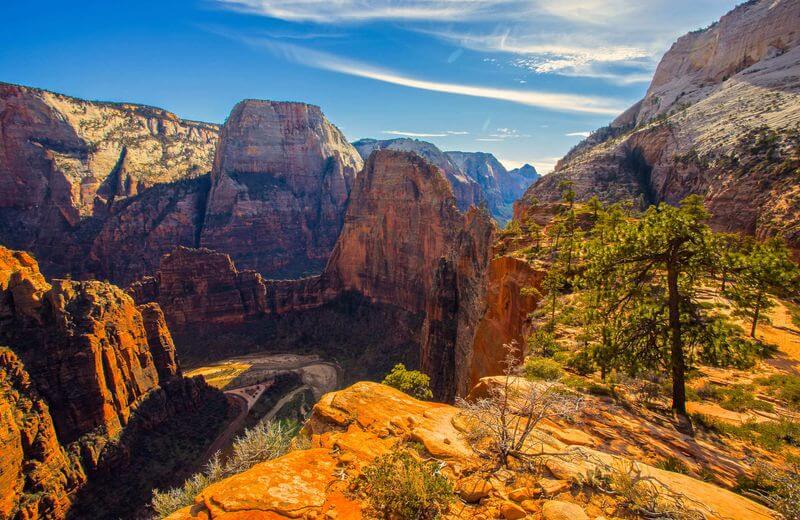
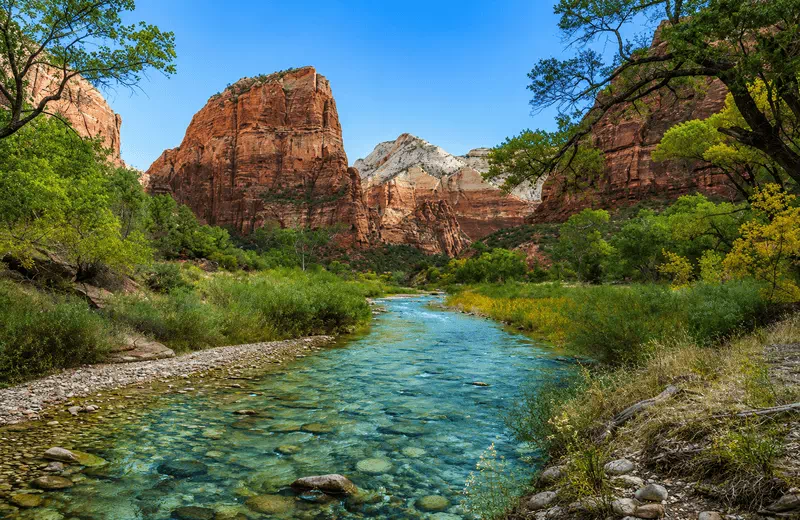
Towering walls of cream, pink, and red sandstone. A green river slicing through a canyon so deep it swallows the sky. The first time you stand on the canyon floor and look up, Zion National Park does something to you that no photo ever managed. But here is the honest truth nobody tells first-timers: Zion can also overwhelm you fast. A mandatory shuttle, permit-only hikes, parking that vanishes by mid-morning, and a layout spread across three separate sections. Get the logistics wrong and you spend your day in lines instead of canyons.
This guide fixes that. Everything a first-time visitor needs, from when to go and how to get there to which hikes are worth your legs and where to sleep, is laid out so your trip runs smooth from the moment you arrive.
Your no-stress roadmap to a first visit at Zion, covering the shuttle, permits, best hikes, smart itineraries, and where to stay near the park.
Zion at a Glance
| Detail | Quick Answer |
|---|---|
| Location | Southwestern Utah, near the town of Springdale |
| Established | Utah's first national park (since 1919) |
| Size | About 229 square miles (roughly 147,000 acres) |
| Famous for | Zion Canyon, The Narrows, Angels Landing, red sandstone cliffs |
| Carved by | The Virgin River |
| Time zone | Mountain Time |
| Nearest big airport | Harry Reid International, Las Vegas (about 2.5 to 3 hours by road) |
| Closest airport | St. George Regional (roughly 1 hour) |
| Getting around | Free park shuttle (peak season) or your own car (off-season) |
| Ideal trip length | 2 to 3 days for first-timers |
Why Zion Hits Different
Zion sits on the western edge of the Colorado Plateau, where the Virgin River has spent millions of years carving a narrow gorge into solid sandstone. The result is a canyon whose walls climb as high as 2,000 feet straight up from the floor. You do not just look at Zion. You walk inside it, with cliffs pressing in on both sides and the river running at your feet.
What makes it special for a first visit is the contrast packed into a small area. One trail wades through a slot canyon barely wide enough for outstretched arms. Another clings to a knife-edge ridge with chains bolted into the rock. A third is a flat, paved riverside stroll your grandparents could enjoy. Few parks hand you that much variety within a single morning.
The park is also one of the most visited national parks in the United States, drawing well over four million people a year. That popularity is exactly why a little planning pays off so heavily.
Best Time to Visit Zion National Park
There is no truly bad time, but each season trades one perk for another.
Spring (around March to May) is the sweet spot for most first-timers. Temperatures are comfortable for hiking, the Virgin River runs full, and waterfalls along the Emerald Pools trails are at their best. The catch: spring runoff can make The Narrows too high and dangerous to enter, so check conditions.
Fall (around September to November) rivals spring as the best season. The brutal summer heat fades, crowds thin slightly after the school rush, and cottonwoods along the river turn gold. Hiking weather is close to perfect.
Summer (around June to August) brings long days but punishing heat. The canyon floor can climb past 100°F, turning exposed hikes into a slog. Smart visitors flip the script: this is prime time for The Narrows, where wading the cool river is a relief rather than a risk. Start early, carry serious water, and rest in the afternoon.
Winter (around December to February) is Zion's quiet secret. Crowds shrink, the red cliffs look stunning under a dusting of snow, and the shuttle mostly stops running, meaning you can drive the scenic road yourself. Trails can be icy and higher routes may close, so pack traction and layers.
If your only goal is the best balance of weather and manageable crowds, aim for late spring or early fall, and always start your hiking day at sunrise. Early arrival fixes most of the problems people blame on Zion.
How to Reach Zion National Park
Zion is more accessible than its remote-canyon looks suggest, mostly thanks to two nearby airports and one very straightforward highway.
By air. The biggest and usually cheapest option is Harry Reid International Airport in Las Vegas, with the deepest rental-car inventory and the lowest prices thanks to heavy competition. From there it is roughly a 2.5 to 3 hour drive. If you would rather arrive at the Strip first and ease into the trip, here is a handy breakdown of getting to the Las Vegas Strip before you point the car north. The closer alternative is St. George Regional Airport, only about an hour away, served by a handful of daily flights from hubs like Salt Lake City, Denver, Dallas, and Phoenix. Salt Lake City International is farther (around 4.5 hours) but useful if you are touring northern Utah too.
By road. From Las Vegas the route is almost foolproof: take I-15 north to St. George, then State Route 9 east through the gateway town of Springdale to the south entrance. The drive cuts through the dramatic Virgin River Gorge along the way. For a complete route breakdown including timing, fuel stops, and cost, this step-by-step guide to reaching Zion from Las Vegas covers it all.
Without a car. It is possible but limiting. A public bus runs the St. George to Springdale corridor several days a week, and private shuttle companies link Las Vegas and St. George to Springdale. But the moment your plans stretch beyond the main canyon, into Kolob Canyons, Kolob Terrace, or the east side, you will need your own vehicle.
Fuel up before your final approach. There are no gas stations inside the park, and Springdale's lone station charges tourist prices. Top off in St. George or Hurricane instead.
Getting Around: The Zion Shuttle Explained
This is the single most important thing a first-timer must understand, because it changes how your entire day works.
For most of the year, roughly mid-March through late November (plus some February weekends and the late-December holiday stretch), the Zion Canyon Scenic Drive is closed to private vehicles. To reach the canyon's famous trailheads, you ride the free park shuttle. No ticket, reservation, or permit is needed to board, and buses come frequently. There are actually two free systems working together: the Springdale town shuttle, which links hotels and parking to the park entrance, and the Zion Canyon shuttle, which runs the scenic drive to nine stops.
In the off-season, when the shuttle is parked for winter, you can simply drive the scenic road in your own car.
The practical headache is parking. The lots inside the park near the visitor center typically fill between 8 and 9 a.m. Miss that window and you will park in Springdale and ride the town shuttle in, which works fine but eats time.
Arrive at the park before 8 a.m. Secure a parking spot, catch one of the first shuttles, and you sidestep the hour-long midday boarding lines that ruin so many first visits.
How Many Days Do You Need? Sample Itineraries
For a first trip, two to three days is the sweet spot. One day works if it is all you have, but it is a highlight reel, not the full film.
One day (the highlight run). Take the first shuttle of the morning to the end of the line at Temple of Sinawava and walk the flat, paved Riverside Walk. Work your way back with stops at the Emerald Pools and a lunch break near Zion Lodge. If energy and a permit allow, tackle Angels Landing or its no-permit alternative to Scout Lookout. Finish with the short, jaw-dropping Canyon Overlook Trail on the east side near the tunnel.
Two days (the comfortable version). Spend day one on the canyon-floor classics above. Dedicate day two to a bigger objective such as The Narrows (gear up early) or Observation Point from the east side, then unwind in Springdale.
Three days (the well-rounded trip). Add a third day exploring beyond the main canyon, either the quieter, dramatic Kolob Canyons section off I-15 or a stargazing evening under Zion's certified dark skies. With an extra day you can also pair Zion with a nearby park, since how to reach Bryce Canyon shows just how close that red-rock wonderland sits.
If you are building a bigger southern-Utah loop, the route also opens the door to reaching the Grand Canyon from Las Vegas and the lesser-known but stunning Capitol Reef National Park, two more pieces of Utah's celebrated national-park country.
Top Places to See and Best Hikes in Zion
Here are the experiences that define a first visit, from gentle to grueling.
Riverside Walk. A flat, paved one-mile path tracing the Virgin River to the mouth of The Narrows. Easy, accessible, and a perfect first taste of the canyon. Allow about an hour.
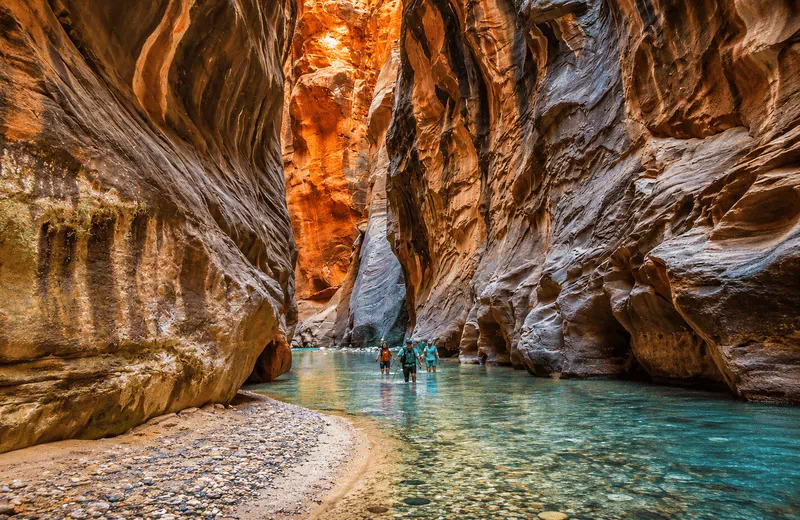
The Narrows (bottom-up). Zion's most iconic adventure. You hike in the river, wading between sheer walls that soar over a thousand feet and squeeze as narrow as 20 to 30 feet apart. The bottom-up route from Riverside Walk needs no permit. Rent proper gear in Springdale, and treat flash-flood warnings as absolute.
Flash floods are the real danger in The Narrows, not the cold water. Always check the park's flash-flood forecast before entering, and never go in when storms are possible, even miles away.
Angels Landing. The bucket-list thriller: a steep climb finishing along a narrow spine with chains bolted into the rock and sheer drops on both sides. The final chained section from Scout Lookout to the summit requires a permit for every hiker, year-round, won through a lottery (more below). The full route runs just over five miles round trip and takes four to five hours.
Scout Lookout (no permit). Hiking the West Rim Trail up to Scout Lookout is permit-free and rewards you with much of Angels Landing's view minus the chains. A great plan B if you miss the lottery.
Emerald Pools. A classic family-friendly network of trails leading to pools and seasonal waterfalls. Lower pool is easy; upper pools add effort and payoff.
Observation Point. Higher than Angels Landing and arguably the best view in the park, looking down on the entire canyon. The classic route is often accessed from the east side via Mount Carmel.
Canyon Overlook Trail. Short, big reward. A roughly one-mile round-trip on the east side near the Zion-Mount Carmel Tunnel that ends at a sweeping canyon viewpoint. Parking is tight, so arrive early.
Pa'rus Trail. A flat, paved riverside path that is the only trail in Zion open to bikes and pets. Lovely for sunrise and sunset.
Image suggestion: A hiker wading through the slot-canyon section of The Narrows with towering walls overhead. Alt text: "Hiker walking through the Virgin River between the steep walls of The Narrows in Zion National Park."
Permits You Need to Know About
Two famous experiences sit behind permits, and missing the rules ruins plans.
Angels Landing requires a permit for the chained summit section, applied for on Recreation.gov. You can enter a seasonal lottery months ahead or a day-before lottery for last-minute luck. There is a small non-refundable application fee plus a per-person fee if you win. Because fees and lottery dates change, confirm the current details on the official site before you plan.
The Narrows top-down route (a longer, one-direction trek) needs a wilderness permit. The popular bottom-up day hike does not.
Budget: What Zion Actually Costs
Costs are in US dollars, and the figures that shift over time are flagged so you can verify them.
Entrance fee. A private vehicle pass runs about $35 and covers everyone in the car for up to seven days. Motorcycles and per-person (cyclist or walk-in) rates are lower. If you plan to visit several national parks in a year, the America the Beautiful annual pass often pays for itself.
International heads-up: non-U.S. residents currently pay an extra per-person surcharge on top of the standard entrance fee at Zion. Because this policy and its amount can change, confirm the current rate on the official NPS Zion page before you travel.
Stay. Budget travelers can find motels and campgrounds; mid-range hotels cluster in Springdale; the in-park Zion Lodge is the splurge. Camping inside the park is reservation-based and limited.
Food. Springdale has everything from casual cafes to sit-down restaurants. Packing your own lunch and water saves both money and time, since there is limited food inside the canyon.
Transport. The park shuttle and Springdale town shuttle are free. Your main costs are the rental car and fuel.
Saving tips: travel in the shoulder or off-season, pack picnic meals, stay in Hurricane or St. George for cheaper rooms, and use the free shuttles instead of fighting for in-park parking. Entrance fees themselves are waived on a handful of fee-free days each year.
Where to Stay and What to Eat
Inside the park. Zion Lodge is the only lodging within the park itself, prized for its location right on the canyon floor. It books out far in advance, so reserve early.
Springdale (just outside the south entrance). This is the practical first-timer base. The town hugs the park gate and is connected by the free town shuttle, so you can stay car-free once you arrive. Options span budget motels, mid-range hotels, and a few luxury and glamping stays nearby.
Farther out. Hurricane and St. George offer cheaper rooms and more chains if you do not mind a longer morning drive.
Camping. The in-canyon Watchman Campground is open year-round and reserved through Recreation.gov. A primitive option exists at higher elevation seasonally. Always confirm which campgrounds are open, since sites sometimes close for maintenance.
Food. Springdale's restaurants cover pizza, Mexican, hearty American fare, and good coffee, with patios facing the cliffs. Inside the park, dining is limited to the Zion Lodge area, so plan to carry snacks and plenty of water for trail days.
Smart Travel Tips for First-Timers
- Carry far more water than you think. The desert heat is deceptive; aim for at least a gallon per person on strenuous summer hikes.
- Start early, every day. Sunrise starts mean cooler trails, open parking, and shorter shuttle lines.
- Cell service is poor. Download maps, permits, and the shuttle schedule before you arrive.
- Watch for wildlife on the roads. Bighorn sheep, mule deer, and wild turkeys roam freely, often at dawn and dusk.
- Pets are restricted. They are only allowed on the Pa'rus Trail, not the main hiking trails.
- Mind vehicle size at the tunnel. Oversized vehicles face restrictions on the Zion-Mount Carmel Highway; check current rules if you drive a large RV or tow a trailer.
- Respect flash-flood and heat warnings. They exist because the canyon is unforgiving, not for decoration.
- Layer for winter. Days can be mild, but icy trails and snow on the rims demand traction and warm gear.
Best Spots for Photos
Zion rewards photographers willing to chase light. The cliffs glow most intensely at sunrise and sunset.
- Canyon Junction Bridge at sunset, for the classic shot of the Watchman peak lit gold above the Virgin River.
- The Narrows, where soft light filters between the walls (waterproof protection for your gear is a must).
- Canyon Overlook, for a sweeping high-angle view of the main canyon, ideal near golden hour.
- Court of the Patriarchs, a quick stop for three towering peaks in one frame.
- Dark skies after dusk, since Zion is a certified dark-sky park and the Milky Way arcs over the sandstone on clear nights.
A wide-angle lens captures the cliffs, while a sturdy bag and rain cover protect against river spray and dust. Bring a small tripod for low-light and night shots.
Wrap-Up: Make Your First Zion Trip Count
Zion is unforgettable, but it rewards the prepared. Remember the three things that make or break a first visit: understand the shuttle, arrive early, and plan around the season and any permits you want. Nail those, and the rest, the canyon, the river, the cliffs that make you feel wonderfully small, takes care of itself.
Your clear next step: pick your travel season, lock in a Springdale stay or campsite as early as you can, and if Angels Landing is on your list, mark the permit lottery on your calendar. Then go let Zion do the thing photos never could.