








Introduction
I'll never forget standing in Auckland's Britomart precinct during Friday rush hour, surrounded by thousands of commuters flooding off ferries and trains, briefcases swinging, footsteps echoing—and feeling utterly, inexplicably calm. This wasn't meditation or travel euphoria talking. Something about the quality of the chaos was fundamentally different from London's Tube, New York's Grand Central, or Tokyo's Shibuya crossing.
The noise level was lower despite similar crowd density. People moved with purpose but without aggression. There was space—physical and psychological—even in the press of bodies. And most strikingly, within five minutes' walk in any direction, that urban intensity dissolved into harbor views, parks, or quiet residential streets where the city noise became mere background hum.
This paradox defines the New Zealand experience: a country that manages to feel peaceful even when it's objectively busy, crowded, or chaotic. It's not that New Zealand lacks urban centers, tourist crowds, or commercial hustle. Auckland has 1.7 million people. Queenstown's streets overflow with visitors during peak season. Rotorua's geothermal parks see thousands of daily tourists. Yet somehow, these places retain an underlying tranquility that visitors consistently notice but struggle to explain.
After two decades of studying how place affects human psychology—and fifteen years living between New Zealand and other developed nations—I've identified the specific, measurable factors that create this phenomenon. This isn't mysticism or marketing. It's a combination of urban design, cultural patterns, environmental factors, and demographic realities that together produce an experience of peace that persists even in New Zealand's busiest environments.
Understanding why New Zealand feels peaceful changes how you travel there. You stop chasing remote wilderness thinking that's where calm exists, and start noticing the sophisticated systems creating tranquility in unexpected places—systems other countries could learn from but rarely do.
The Proximity Principle: Wilderness Within Reach
New Zealand's secret weapon against urban stress isn't that cities are small—it's that wilderness is close. This proximity creates psychological safety valves that fundamentally alter how urban environments feel, even when you're not actively using the escape routes.
In Auckland, you're never more than thirty minutes from serious nature—not manicured parks, but actual wilderness. Waitakere Ranges rainforest, Hauraki Gulf islands, Hunua Ranges, regional parks with hiking trails that see maybe five people per day. This isn't theoretical access requiring extensive planning—it's practical proximity that shapes daily life and urban psychology.
The psychological impact of knowing you can escape creates calm even when you're not escaping. Environmental psychology research confirms this: people in cities with visible, accessible natural areas report lower stress levels even when measured during workdays when they're not in those natural areas. The mere knowledge of proximity provides psychological benefit.
Wellington demonstrates this principle perfectly. The city center is genuinely urban—high-density, busy streets, corporate headquarters, government buildings. But the harbor dominates the skyline. Hills rise directly from downtown, covered in native bush accessible via walking tracks from the city center. On lunch breaks, office workers walk into Mount Victoria's forests, eat sandwiches overlooking the harbor, and return to desks within forty-five minutes.
This proximity isn't accident—it's conscious urban planning that prioritizes maintaining green corridors and limiting sprawl. New Zealand cities grow up and in rather than endlessly out, preserving the nature-urban interface that gives cities their breathing room.
Contrast this with cities where nature requires serious commitment to reach. Los Angeles spreads so far that accessing mountains means hours of traffic. Tokyo's urban density extends so massively that finding genuine wilderness requires expensive travel. London's countryside is beautiful but decisively separate from urban life, requiring conscious weekend trips rather than spontaneous lunch-hour escapes.
The Kiwi expectation that nature should be accessible doesn't just shape where cities grow—it shapes how they feel. You can be in Queenstown's commercial center, surrounded by tour buses and souvenir shops, and still see mountains dominating the skyline, still hear the Shotover River, still sense the Remarkables looming over everything. The wilderness isn't distant goal—it's present reality, even when you're buying groceries.
Low Population Density: The Math of Space
Here's the stark arithmetic that shapes every New Zealand experience: five million people across 268,000 square kilometers. For context, that's roughly the population of Sydney spread across an area larger than the United Kingdom.
This density—or rather, lack thereof—creates physical space that you feel viscerally even in tourist hotspots. Queenstown during peak summer might have 40,000 people in town (combining residents and visitors). That's genuinely busy by New Zealand standards. But 40,000 people occupying Queenstown's geography still produces less crowding than most mid-sized European cities experience year-round.
The space manifests in subtle ways that compound into profound impact:
Sidewalks accommodate natural walking speeds without constant navigation around slower or faster pedestrians. You're not doing the urban dance of constant micro-adjustments to avoid collision.
Restaurants and cafés have breathing room between tables. You're not eavesdropping on neighbors' conversations because tables are actually separated, not jammed together to maximize seating.
Queues are short and move quickly because infrastructure isn't perpetually overwhelmed by population. Even popular attractions rarely have the crushing wait times common in Europe or Asia.
Traffic exists but rarely reaches gridlock outside Auckland's worst rush hours. Wellington and Christchurch have traffic delays, not traffic paralysis. Queenstown's bottlenecks are frustrating by local standards but laughable compared to Bangkok or Manila.
This space creates something precious: the ability to think. In truly dense urban environments, your brain allocates enormous processing power to navigation, collision avoidance, and managing sensory overwhelm. This cognitive load is exhausting even when you don't consciously notice it.
New Zealand's spatial generosity frees that mental bandwidth. You can walk down Queen Street in Auckland thinking about your conversation, your plans, your observations—not constantly calculating pedestrian trajectories and escape routes. This mental spaciousness registers as peace even when the environment is objectively busy.
The demographic reality also means New Zealand never developed the aggressive territorial behavior that emerges in truly crowded places. Kiwis haven't needed to master the art of ignoring neighbors, claiming personal space through hostility, or treating strangers as obstacles. The abundance of physical space created cultural patterns of openness that persist even in relatively crowded contexts.
Sound Design: The Architecture of Quiet
New Zealand's acoustic environment is dramatically different from most developed nations, and this sonic quality profoundly affects how places feel—yet travelers rarely consciously notice it.
Start with what's missing: New Zealand has minimal industrial noise. The country deindustrialized early, shifting to service and tech economies. There aren't factory districts with constant mechanical grinding. There aren't extensive freight rail networks with perpetual rumbling. Even construction noise is less intense because projects are smaller-scale and regulations stricter.
Traffic noise is lower for multiple reasons. Speed limits are conservative—50 km/h in urban areas, often 30 km/h in residential zones. This isn't just safety regulation—lower speeds mean quieter traffic. Vehicle fleets skew newer and better-maintained, producing less noise than aging cars belching engine sounds. And crucially, traffic volume rarely reaches the threshold where individual vehicle sounds merge into constant roar.
Auckland's motorways get genuinely noisy during rush hour, but even this pales compared to Los Angeles, Mumbai, or São Paulo, where traffic noise is weapon-grade assault on hearing. Most New Zealand cities have quiet hours that actually mean something—residential neighborhoods at night are genuinely quiet, not just "less noisy than daytime."
Building construction emphasizes sound insulation more than many countries. New Zealand's timber-frame construction naturally absorbs sound better than concrete high-rises. Strict building codes around insulation (driven by climate needs) coincidentally improve acoustic separation. You're less likely to hear neighbors, street noise, or commercial activity through walls.
The cultural norms around noise are equally important. Kiwis value quiet. Loud behavior—whether music, conversation, or vehicle noise—draws social disapproval. This isn't enforced through aggressive confrontation but through subtle social pressure and genuine cultural preference for lower volume.
Even in busy tourist areas, notice the acoustic quality. Rotorua's commercial center has crowds, but you can still hear individual conversations, bird calls, the rustle of wind through trees. Queenstown's waterfront is packed with people, but it doesn't produce the wall of sound characteristic of comparable tourist destinations.
This acoustic spaciousness operates below conscious awareness for most people, but it profoundly affects stress levels. Environmental psychology research consistently links chronic noise exposure to elevated stress hormones, reduced cognitive function, and decreased wellbeing. The absence of noise pollution isn't just pleasant—it's psychologically restorative in ways that accumulate over time.
The "She'll Be Right" Tempo: Cultural Pace
New Zealand's famous "she'll be right" attitude isn't just about optimism—it's about tempo. Kiwis operate at a fundamentally different pace than most developed economies, and this collective rhythm creates calm even in theoretically high-pressure situations.
Watch a busy Auckland café during morning rush. Yes, there's activity—people ordering, baristas working, customers coming and going. But notice what's absent: no one's shouting orders, no one's aggressively pushing through the queue, no one's treating service workers like obstacles to their caffeine acquisition. The efficiency exists, but it's smooth rather than frantic.
This pace stems from several cultural factors. New Zealand's small size means you might encounter the same people repeatedly. The barista you're rude to today might be your server tomorrow or your colleague's friend next week. This social proximity encourages civility and patience that larger anonymous cities don't require.
The outdoor lifestyle also shapes tempo. Kiwis structure life around getting outside—surfing before work, hiking on weekends, leaving early on Fridays for road trips. This priority means that work, while important, doesn't consume identity the way it does in cities where career defines worth. People move through work tasks efficiently to preserve time for what actually matters: the outdoors, family, personal pursuits.
"She'll be right" also creates tolerance for imperfection that reduces stress. If your coffee takes an extra minute because the machine needed adjustment, that's not crisis—it's minor inconvenience. If the shop closes early because the owner wanted to catch good surf, that's not unprofessional—it's priorities aligned correctly. This acceptance of variability means people aren't perpetually stressed about controlling every variable.
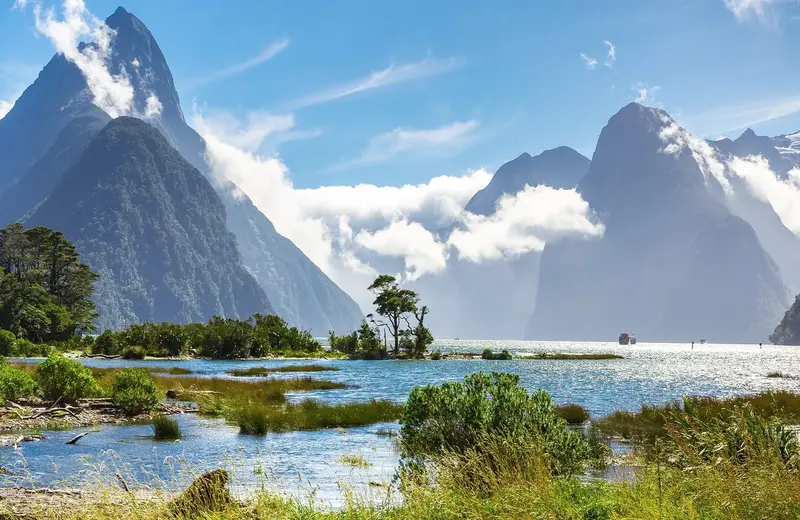
Even tourist businesses, which theoretically should operate on intense service-industry tempo, often retain this characteristic Kiwi pace. Your Milford Sound cruise might start ten minutes late because they're waiting for stragglers or dealing with equipment checks. Guides aren't rushing through scripted presentations—they're chatting genuinely, answering questions thoroughly, allowing moments of silence for people to simply experience the environment.
This tempo frustrates some travelers, especially those from hyper-efficient cultures who interpret anything slower than maximum speed as incompetence. But it's precisely this resistance to frantic pace that creates the peaceful quality even busy New Zealand places maintain.
Green Urban Design: Nature Integrated, Not Segregated
New Zealand cities don't just have parks—they weave nature through urban fabric in ways that create constant visual and psychological relief from built environment density.
Auckland's volcanic cones remain preserved within the urban area—Mount Eden, One Tree Hill, Mount Hobson, and dozens more. These aren't manicured parks with mown grass. They're protected natural areas where native vegetation grows, birds nest, and walking tracks wind through ecosystems largely unchanged despite surrounding suburbs. This means Auckland residents live among nature, not next to parks.
Wellington's Town Belt encircles the city—200 hectares of native forest, accessible via walking tracks from downtown, creating green skyline wherever you look. You can be in dense urban core and still see hills covered in green rather than buildings extending to horizon.
Christchurch rebuilt after devastating earthquakes with explicit commitment to green space. Hagley Park's 165 hectares provide massive breathing room adjacent to central city. But equally important are the smaller interventions—pocket parks, green corridors along streams, native plantings in commercial areas, and the Avon River winding through the city center with natural banks rather than concrete channels.
Even smaller cities maintain this pattern. Tauranga, Palmerston North, Dunedin—all integrate green space as essential infrastructure, not optional amenity. This isn't accident—it's policy reflecting cultural values that prioritize environmental quality alongside economic development.
The psychological impact of this green infrastructure is well-documented. Views of nature reduce stress hormones measurably. Access to green space improves mental health outcomes. Even brief visual contact with trees and vegetation provides restorative benefits. New Zealand's urban design delivers these benefits not as special experiences requiring park visits, but as constant background presence.
Notice the difference in how this feels compared to cities where nature is segregated into parks. In Manhattan, you have Central Park—magnificent, essential, heavily used. But between park visits, you're in stone and steel canyon. The psychological relief parks provide is intense but periodic.
In Wellington, you're never far from green. Your walk to work probably includes native trees. Your lunch spot probably overlooks harbor and hills. Your evening includes sunset views over vegetated slopes. The restorative effect is continuous rather than episodic, creating baseline calm that persists even during busy workdays.
The Small-Town Psychology of Big Cities
New Zealand's largest city, Auckland, has 1.7 million residents—which by global standards barely qualifies as large. Wellington has 215,000. Christchurch 380,000. These population numbers create social dynamics more characteristic of large towns than international metropolises, and these dynamics profoundly affect how places feel.
In cities of this size, networks overlap constantly. Your barista's friend is your colleague's partner. Your neighbor works at the company your friend's applying to. The person you're rude to in traffic might be interviewing you next week. This social proximity creates accountability and encourages civility that truly anonymous cities don't maintain.
The small population also means limited social stratification. Yes, New Zealand has inequality, but you don't have the rigid class separation of London, the wealth canyons of New York, or the geographic segregation of Los Angeles. CEOs shop at the same supermarkets as students. Politicians ride public buses. Rugby players drink at regular pubs. This mixing creates democratic public space where everyone occupies the same environments.
This egalitarian space-sharing means New Zealand cities don't develop the hostile territorial behavior characteristic of highly stratified cities. There aren't neighborhoods where your presence immediately marks you as outsider. There aren't unspoken rules about who belongs in which spaces. The psychological safety this creates allows genuine relaxation even in busy public areas.
The cultural memory of small-town origins also persists even as cities grow. Many urban Kiwis grew up in genuinely small towns and carry those social patterns into cities—greeting strangers, stopping to help, assuming good intentions, giving people benefit of the doubt. These behaviors create warm social fabric that softens urban anonymity.
Even tourists benefit from this dynamic. In massive international cities, you're one of millions—utterly anonymous, easily ignored, often invisible. In New Zealand cities, you're still noticeable. Locals will chat in queues, offer directions unprompted, recommend restaurants spontaneously. This friendliness isn't performance—it's genuine small-town hospitality scaled up to city size but not yet extinguished by urban growth.
Weather's Subtle Role: The Calming Power of Changeability
New Zealand's famously changeable weather—"four seasons in one day"—might seem like stress factor, but it actually contributes to the peaceful quality of place in unexpected ways.
The variability prevents heat-induced aggression that plagues cities with extreme summer temperatures. Auckland occasionally hits 30°C, but sustained heat waves are rare. There's no equivalent to the grinding heat that makes tempers flare in Mumbai, Phoenix, or Dubai. The temperate, changeable climate keeps physical discomfort from becoming constant background stressor.
The changeability also creates cultural acceptance of weather's unpredictability, which reduces stress around planning and control. Kiwis expect plans to shift based on weather. That outdoor event might move indoors. That hike might get postponed. This flexibility becomes habit, creating population-wide resilience to disrupted expectations.
The frequent wind, while sometimes annoying, also creates constant air movement that prevents stagnant urban atmosphere. Wellington's legendary wind is exhausting, but it also means the air feels perpetually fresh rather than accumulating pollution and humidity. The psychological association between fresh air and cleanliness, between movement and vitality, operates below conscious awareness but affects how the environment feels.
Cloud cover and rain also moderate light intensity in ways that reduce visual harshness. Many New Zealand cities have soft, diffused light quality more often than harsh sun or deep shadow. This gentler light is easier on eyes and creates calmer visual environment than the glaring sun of desert cities or the perpetual dimness of northern European winters.
Conclusion: Peace as System, Not Accident
New Zealand's peaceful quality isn't mystical—it's systematic. It emerges from specific, identifiable factors that compound into experience greater than sum of parts: proximity to wilderness, low population density, acoustic design, cultural tempo, green urban planning, small-town social dynamics, and moderate weather.
Understanding these systems changes how you experience New Zealand. You stop attributing the peaceful feeling to vague "island vibe" and start noticing the sophisticated infrastructure—physical, social, and cultural—that creates and maintains tranquility even under pressure of tourism and development.
This understanding also reveals what's at stake. New Zealand's peace isn't guaranteed by geography alone—it requires ongoing commitment to planning decisions that prioritize spaciousness over density, nature integration over maximum development, acoustic quality over economic efficiency, and cultural tempo over competitive acceleration.
The peaceful quality already shows strain in places. Auckland's growth creates genuine traffic problems. Queenstown's tourism success produces seasonal crowding that tests infrastructure. Tourist hotspots experience pressure that threatens the very qualities that made them attractive.
But the fundamental systems remain largely intact. New Zealand still plans cities with nature integration as priority. Cultural values still resist frantic pace. Social dynamics still reflect small-town origins. Acoustic environments still prioritize quiet. Population density still provides breathing room.
For travelers, the lesson is profound: peace isn't found only in remote wilderness. It exists in busy places when those places are designed, culturally shaped, and consciously maintained to preserve human-scale environments even as they grow.
New Zealand's cities demonstrate that you don't have to choose between urban vitality and environmental calm, between economic activity and psychological peace, between busy and peaceful. You can have both—if you build systems that prioritize wellbeing alongside growth, if you maintain green infrastructure as fiercely as economic infrastructure, if you protect cultural values around pace and space even as populations expand.
The next time you're standing in busy Queenstown, crowded Auckland, or tourist-packed Rotorua and notice that inexplicable calm—remember it's not magic. It's the result of a thousand deliberate choices about how to build cities, how to move through the world, and what to value when those priorities conflict.
That's the real lesson New Zealand offers: peace is possible even in busy places, but only if you design for it, fight for it, and refuse to sacrifice it for short-term convenience or economic pressure. In a world where most cities are racing toward maximum density, speed, and intensity, New Zealand's peaceful busy places stand as evidence that another way is possible.