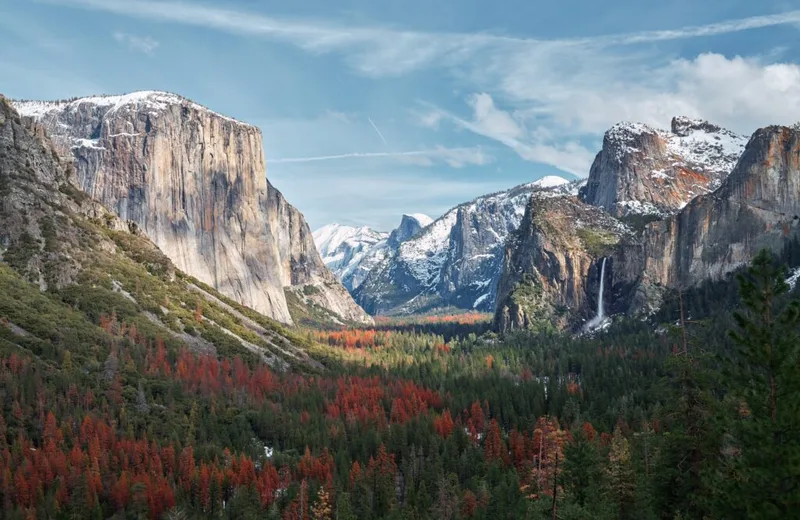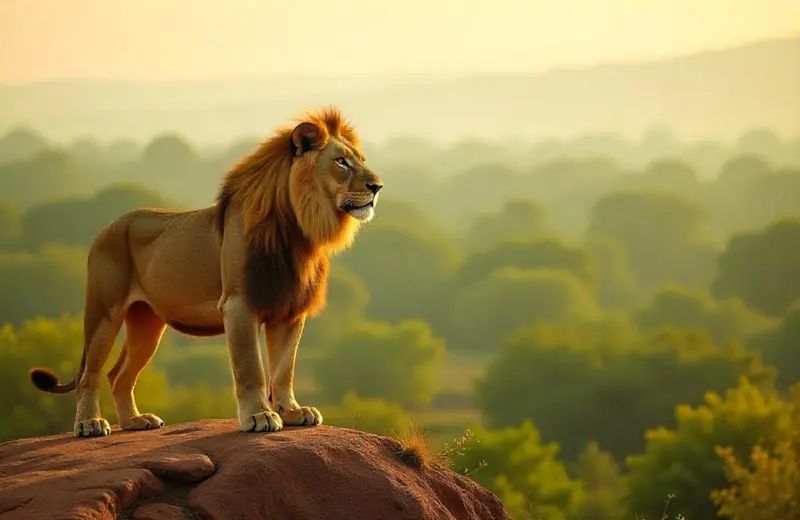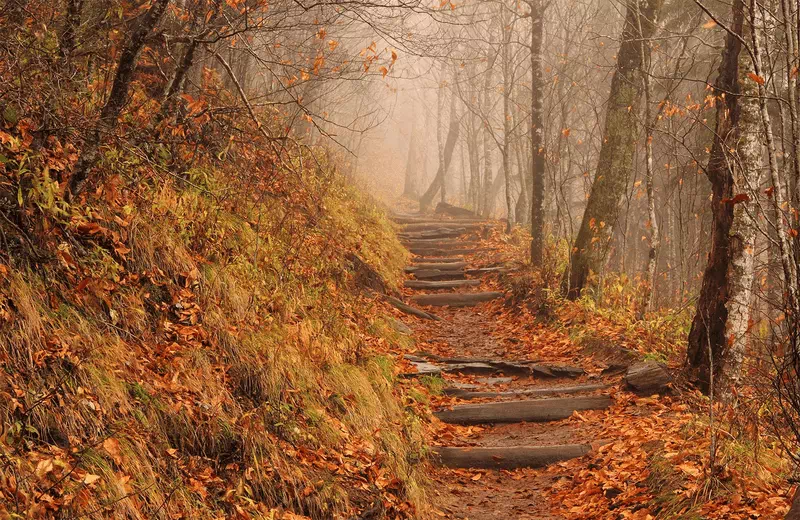
Most people picture Kerala as backwaters and beaches. The hills tell a different story. Drive east toward the Western Ghats and the coconut palms thin out, tea slopes take over, and somewhere past the last plantation a wild elephant can walk out of the mist without a sound. This is where the national parks in Kerala sit. There are six of them, all strung along the same mountain spine, each guarding a slightly different piece of one of the oldest rainforest systems on the planet.
That number matters, because plenty of travel lists get it wrong. Kerala has exactly six national parks, not five, and this guide covers every one of them. You will find what each park protects, the animals you have a real chance of seeing, how to actually visit (boat, jeep, or your own two feet), the best months to go, and the routes in. If you are weighing a wildlife stop against the usual houseboat-and-beach loop, this should help you decide where the forest is worth your time.
Six parks, one mountain range, and a surprising range of ways to meet the wild side of God's Own Country.
Kerala's National Parks at a Glance
Here is the quick version before the detail. Use it to spot which parks cluster together and which one fits the kind of trip you want.
| National Park | District | Best known for | Approx. area | Base yourself in |
|---|---|---|---|---|
| Periyar (Thekkady) | Idukki & Pathanamthitta | Boat safari, wild elephants, tiger reserve | ~350 sq km | Kumily / Thekkady |
| Eravikulam | Idukki (Munnar) | Nilgiri Tahr, Anamudi peak, Neelakurinji | ~97 sq km | Munnar |
| Silent Valley | Palakkad | Untouched rainforest, lion-tailed macaque | ~90 sq km core | Mukkali / Mannarkkad |
| Mathikettan Shola | Idukki | Shola forest, elephant corridor | ~12.8 sq km | Munnar |
| Anamudi Shola | Idukki | Shola-grassland, trekking | ~7.5 sq km | Munnar / Marayoor |
| Pampadum Shola | Idukki | Smallest park, quiet treks, eco-stays | ~1.3 sq km | Munnar / Vattavada |
Four of the six (Eravikulam and the three Shola parks) sit within easy reach of Munnar, so you can string several together on one trip. Periyar is a separate base near the Tamil Nadu border, and Silent Valley sits far to the north in Palakkad. These six are part of the wider network of national parks across India, but the Western Ghats give them a character you will not find in the dry reserves of the north.
What Makes the Wildlife Here Feel Different
Forget the open jeep bouncing through dry scrub. Most of Kerala's wild country is wet, green, and steep. The forests here range from tropical evergreen rainforest to high-altitude shola woodland tucked into folds of grassland above 2,000 metres. That mix is why a small state holds such an odd guest list: the Nilgiri Tahr, a stocky mountain goat that lives nowhere else on earth in such numbers; the lion-tailed macaque, with its silver mane and grave expression; great hornbills; and the usual heavyweights, elephant, gaur, sambar, and the occasional, very lucky, sighting of a tiger or leopard.
The other thing worth knowing early: these are working ecosystems with rules, not zoos. Several parks limit how many people can enter, when, and where. A little planning ahead saves a wasted morning at a closed gate.
Periyar National Park
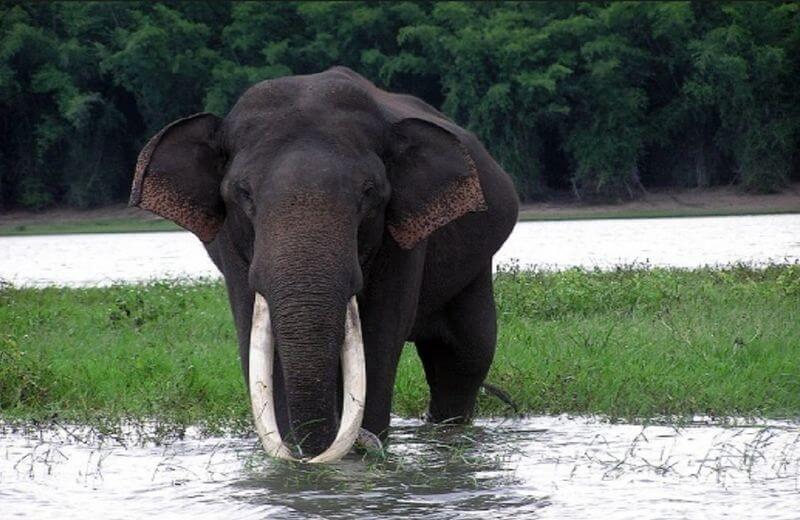
If you only have time for a single park, this is usually the one. Periyar, set around the town of Thekkady in Idukki district, is built around a large artificial lake created when the Mullaperiyar Dam went up in the 1890s. The result is unusual for India: instead of driving to find wildlife, you board a boat and let the animals come to the water.
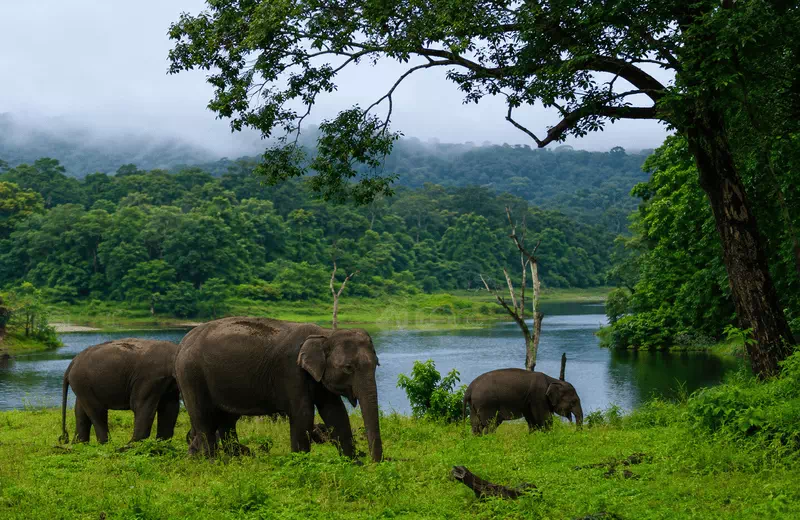
The lake is the heart of the experience. Herds of elephants drift down to drink, gaur graze the shoreline grass, sambar wade in, and otters work the shallows. Birdwatchers do well here too, with darters and kingfishers perched on the dead trunks that poke out of the water. Periyar is also a tiger reserve under Project Tiger, so a striped sighting is technically possible, though you should treat it as a rare bonus rather than a plan.
Beyond the boat, the reserve runs guided options like nature walks, longer treks, bamboo rafting, and night patrols led by reformed poachers who now work as forest guides. The pilgrim town of Sabarimala lies within the larger Periyar Tiger Reserve on the Pathanamthitta side, so if your dates overlap with the Sabarimala pilgrimage season, expect heavier crowds and traffic across the region.
Book the boat safari ahead of time. A share of the seats sells online through the official Periyar Tiger Reserve booking portal, and the counter tickets at the lake can vanish fast in peak months. The early-morning slot is best for birds; the early afternoon raises your odds of large mammals coming down to drink. Always wear the life jacket provided.
Eravikulam National Park: Kerala's First, and the Home of the Nilgiri Tahr
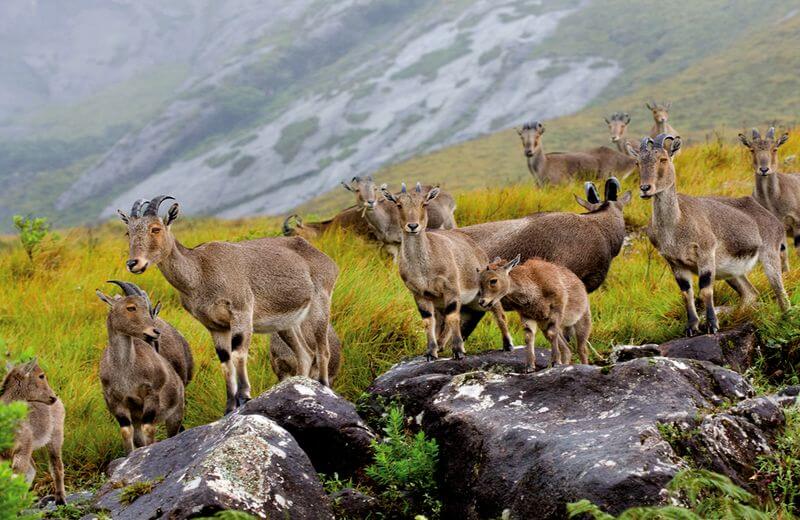
The park covers about 97 sq km of rolling grassland and shola forest, and it carries South India's highest peak inside its boundary: Anamudi, at 2,695 metres. The name means "elephant's forehead," and from some angles the dome of rock does look the part. Tourists only access the Rajamala zone; the core and buffer stay closed to keep the tahr undisturbed. A park bus carries you up from the entrance, and from there it is a walk among the goats with the tea country falling away below.
Eravikulam holds one more trick. Every twelve years or so, its slopes turn purple-blue when the Neelakurinji flowers bloom in unison. The last major bloom was in 2018, and the next is widely expected around 2030, though the exact timing is nature's call, so confirm before building a trip around it.
Eravikulam usually shuts for roughly six weeks during the Nilgiri Tahr calving season, generally from February into March. Dates shift year to year, so check the current status with the forest department before you travel, especially if Munnar is the centrepiece of your plan. While you are in the area, it is worth scanning the other places to visit in Munnar to round out the days.
Silent Valley National Park: The Rainforest That Was Saved
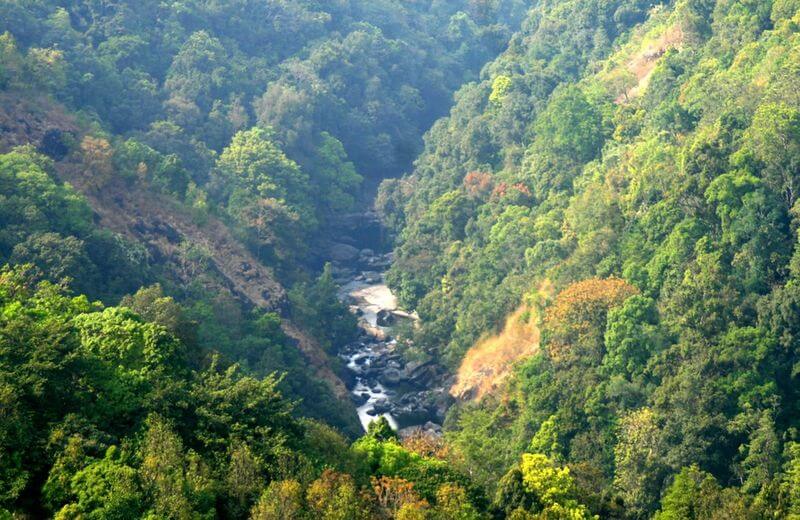
Far to the north in Palakkad district lies the wildest and least visited of the six. Silent Valley protects one of the last large tracts of undisturbed tropical evergreen rainforest in India, sitting at the core of the Nilgiri Biosphere Reserve and recognised as part of the Western Ghats UNESCO World Heritage site. Its core forest covers roughly 90 sq km, ringed by a much larger buffer.
The name has a few origin stories. One points to the forest's unusual quiet, with fewer of the cicadas whose chorus fills most tropical jungles. Another reaches back to the Mahabharata, when the valley was called Sairandhrivanam. What the place is genuinely famous for, though, is being rescued: a planned hydroelectric dam on the Kunthipuzha River in the 1970s and 80s sparked one of India's first big environmental campaigns, and public pressure eventually saved the forest. It was declared a national park in 1984.
Wildlife here leans toward the shy and the rare. Silent Valley holds one of the largest populations of the lion-tailed macaque, along with Nilgiri langur, Malabar giant squirrel, and a long list of birds and butterflies. This is not a drive-up safari park. Entry is controlled, you generally need permission through the forest department, and most visitors reach the interior viewpoint at Sairandhri by forest jeep from the gateway village of Mukkali. Come for the forest itself, the river, and the silence, rather than a guaranteed animal count.
Mathikettan Shola National Park: The Forest That Confuses You
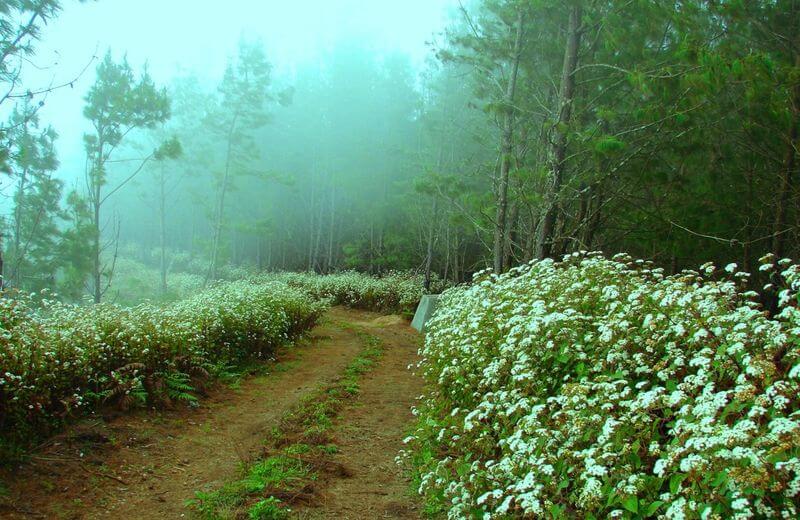
Back in the Munnar belt, Mathikettan Shola is a compact park of about 12.8 sq km in Idukki, sitting along the Munnar-Kumily route near Poopara. The name comes from a Tamil idea of a forest so dense you lose your sense of direction in it, which tells you what kind of place this is.
Its real value is as an elephant corridor and a patch of intact shola woodland, protected since 2003. You may spot gaur, sambar, spotted deer, the Nilgiri marten, and herds of elephants passing through, along with the birds that favour these mid-altitude forests. There are simple viewpoints from where, on a clear day, you can look across into Tamil Nadu. It is a quieter, slower stop than Eravikulam or Periyar, better suited to travellers who like their forests without a crowd.
Anamudi Shola National Park: Three Sholas, One Quiet Reserve
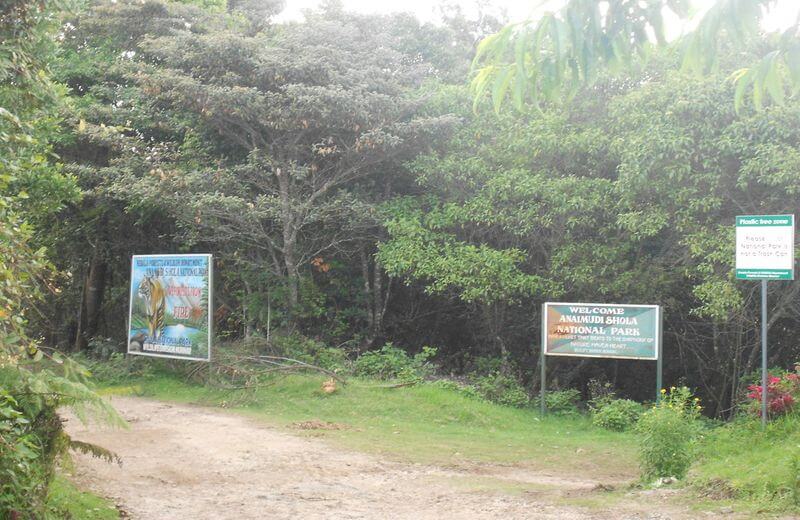
A short note to clear up a common mix-up first: Anamudi Shola National Park is not the same as Anamudi peak. The peak sits inside Eravikulam; this park, about 45 km from Munnar near Marayoor, simply borrows the famous mountain's name. It is made up of three patches of shola forest, Mannavan, Idivara, and Pullardi, covering roughly 7.5 sq km in all, and was declared a national park in 2003 as part of the Anamalai sub-cluster of the Western Ghats World Heritage area.
Mannavan Shola is one of the larger surviving shola stretches in the region, and the park acts as a watershed for rivers like the Pambar. Expect endemic and threatened species: the Nilgiri marten, Indian wild dog, and the high-altitude birds and amphibians that depend on this cool, damp habitat. Guided treks are the way to experience it, and the tea-country views on the approach are part of the reward.
Pampadum Shola National Park: The Smallest, and the Quietest
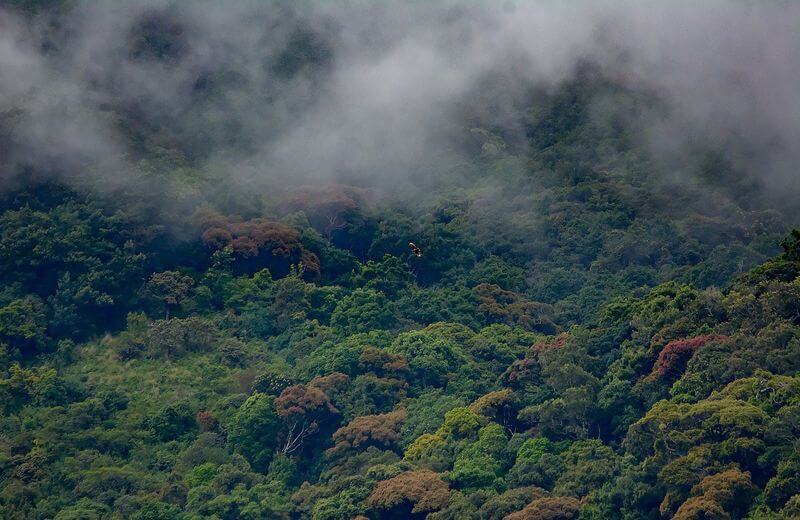
Last comes the smallest national park in Kerala. Pampadum Shola covers barely over a square kilometre near Vattavada, on the Idukki border with Tamil Nadu's Kodaikanal hills. Its name translates roughly as "the forest where the snake dances," and despite the tiny size it punches above its weight ecologically, acting as a corridor that lets animals move between Eravikulam and the Palani Hills.
This is a park for people who like to walk. Trekking trails wind through dense woods toward Vattavada, the forest department runs basic eco-stays such as log and mud houses for those who want a night inside the forest, and the route here threads through the scenic Munnar-Kodaikanal high country near Top Station. If you want the shola experience without another soul in sight, this is your park.
Best Time to Visit the National Parks in Kerala
The sweet spot for most of these parks runs from October to March. The southwest monsoon has cleared out, the air is cool, the forests are at their greenest, and the trails are walkable. Around Munnar, the cold, misty mornings of this window are some of the prettiest in South India.
There are a couple of nuances. At Periyar, the hot, dry stretch of March and April can actually be better for wildlife, because falling water levels pull animals down to the lake. At Eravikulam, plan around the calving-season closure in roughly February to March. The monsoon months of June to September turn the hills lush but make trekking slippery and leech-prone, and some forest activities pause. If waterfalls are your thing, that is when nearby spots like the Athirappilly waterfalls roar at full force, which can pair nicely with a hill trip.
How to Reach Kerala's National Parks
Because the parks fall into three clusters, it helps to think about your route by base town rather than by individual park.
For the Munnar group (Eravikulam plus the three Shola parks), Munnar is your hub. The nearest airport is Cochin International near Kochi, roughly 110 to 130 km away and about a four-hour drive through the hills. The closest railheads are Aluva and Ernakulam Junction, both around the same distance, after which you continue by taxi or bus. From Munnar, Eravikulam is barely 8 km away, while Pampadum Shola (toward Vattavada) and Anamudi Shola (toward Marayoor) are day trips of 35 to 45 km, and Mathikettan Shola sits along the road toward Kumily.
For Periyar, base yourself in Kumily, with Thekkady just 4 km on. Madurai airport in Tamil Nadu is the nearest at about 140 km, while Cochin is roughly 190 km. The closest railway station is Kottayam, around 110 km away, with onward buses and taxis. Handily, Munnar to Kumily is also about 110 km, so many travellers chain the Munnar parks and Periyar into one loop.
For Silent Valley, head to Palakkad in the north. Palakkad Junction is the practical railhead, while Coimbatore airport (in Tamil Nadu) is the usual flying-in point. From there you reach the gateway village of Mukkali, and the forest jeep takes you on to the Sairandhri viewpoint. Remember that entry needs prior forest-department permission, so this one rewards a phone call before you set out.
If you are short on time, treat the parks as two trips, not one. The Munnar-Thekkady loop is a comfortable four-to-five-day circuit on its own. Silent Valley sits in a different corner of the state and really deserves to be paired with Palakkad or a northern Kerala route instead.
Safaris, Treks and Activities: What You Can Actually Do
Each park offers a different way in. Periyar is all about the lake, with its boat safari, plus guided treks, bamboo rafting, and night walks bookable through the reserve. Eravikulam is a managed walk-up among the tahr in the Rajamala zone, reached by the park's own shuttle. Silent Valley is a permit-based jeep ride to a viewpoint and short guided forest walks. The three Shola parks are mostly about trekking with a guide through shola-grassland country.
Fees, timings, slot numbers, and the rules around online booking change from season to season and are revised by the authorities fairly often. Rather than trust any fixed figure you read online, check the current details on the official Kerala Forest Department and Kerala Tourism websites, or the Periyar Tiger Reserve portal, close to your travel dates. Carrying a printout or screenshot of any confirmed booking saves arguments at the gate.
Travel Tips Worth Knowing Before You Go
A few practical things make these trips smoother. The hills get genuinely cold at dawn, even in summer, so a light fleece earns its place in your bag alongside sturdy shoes with grip for wet, rooty trails. During and just after the monsoon, leeches are a fact of life in the wetter forests; tucking trousers into socks and carrying a little salt or repellent keeps them at bay without much fuss. Cash is wise to carry, since ATMs thin out the deeper you go into the hills and small forest counters may not take cards.
On the wildlife front, the boring advice is the useful advice. Keep your distance from the tahr and the elephants no matter how tame they look, never feed any animal, and keep noise down if you actually want to see something. Plastic is banned or frowned on across most of these parks, so carry your waste back out. And if a guide is offered or required, take one; they read the forest in a way a first-timer simply cannot, and the fee is small against what you will notice with them along.
It is also easy to fold a park or two into a broader Kerala route. After a few days in the forest, many travellers swing down to the famous temples in Kerala or unwind on the quiet sands of Marari Beach before flying home, turning a wildlife trip into a fuller picture of the state.
Where to Stay
Around Munnar you will find the full range, from backpacker hostels and homestays among the tea estates to mid-range hotels and a handful of plantation resorts with valley views. Kumily and Thekkady, the base for Periyar, offer everything from budget lodges to spice-garden retreats and a few high-end stays close to the reserve gate. For the Shola parks and Vattavada, homestays and the forest department's own eco-stays put you closest to the trailheads. Silent Valley is more remote, so most visitors stay around Mukkali, Mannarkkad, or Palakkad town and make a day of the park. Book ahead in the October-to-March season, when Munnar in particular fills up fast.
A Simple Itinerary to Tie It Together
If you want a ready route rather than a pile of options, the Munnar-Thekkady loop does the heavy lifting. A four-day version works well for most travellers. Land at Kochi and drive up to Munnar, keeping the first afternoon light after the long climb. Give the second morning to Eravikulam, going early to beat both the crowds and the cloud, then spend the rest of the day among the tea estates and a nearby Shola park if you have the energy. On the third day, move across to Kumily, roughly a four-hour drive, and settle in near Thekkady. Save the fourth morning for the Periyar boat safari, which is at its best soon after the gates open, before turning back toward Kochi.
Stretch that to five or six days and you can slot in Pampadum Shola or Mathikettan Shola, a spice-plantation walk around Thekkady, or a slow day doing very little in the hills, which is no bad thing after early starts. Silent Valley, as noted, does not fit this loop and is better saved for a separate northern trip through Palakkad. Whatever shape your plan takes, build in a buffer for hill traffic and the odd closed gate, and you will rarely feel rushed.
Final Word: Which Park Should You Choose?
Kerala's six national parks are not interchangeable, and that is the point. Go to Periyar for the boat safari and the best odds of big mammals, to Eravikulam for the Nilgiri Tahr and Anamudi, and to Silent Valley for raw, protected rainforest and silence. The three Shola parks reward anyone willing to walk for a quieter, less-photographed side of the Western Ghats. The simplest plan for a first visit is the Munnar-Thekkady loop, which folds four of the six into a single comfortable week.
Your next step is easy: pick your base, lock down October-to-March dates if you can, and check the official forest-department pages for current timings and bookings before you set off. Do that, and the wild half of God's Own Country is yours.