









The Sound of Silence: Finding Calm in New Zealand’s Landscapes
There’s a moment many travelers experience in New Zealand that’s difficult to describe until it happens to you. You stop walking. The wind drops. The mountains seem to hold their breath. And suddenly you notice something unusual: nothing.
No traffic hum. No distant sirens. No crowds. Just the quiet rhythm of the natural world.
It’s a silence so complete that you start hearing things you normally miss—the ripple of a lake, the crunch of gravel under your boots, even your own breathing.
In a world where most destinations compete to be louder, brighter, and busier, New Zealand offers something increasingly rare: space and silence. This country’s landscapes aren’t just beautiful; they’re restorative. And if you travel thoughtfully, you can experience some of the calmest, most peaceful places left on Earth.
This guide isn’t about ticking off famous landmarks. It’s about discovering where the quiet lives—and how you can experience it for yourself.
Why Silence Feels Different in New Zealand
Silence exists everywhere, but in New Zealand it feels… deeper.
There are a few reasons for that.
First, geography. With dramatic mountains, deep fjords, and enormous national parks, large parts of the country remain almost untouched. Vast areas of the South Island, in particular, are protected wilderness.
Second, population. The entire country has only about five million people spread across islands roughly the size of the United Kingdom. Once you leave major cities like Auckland or Wellington, the landscape quickly opens up.
And finally, there’s the culture. New Zealand travel tends to lean toward hiking, nature, and slow exploration rather than high-energy sightseeing.
The result? A destination where quiet isn’t just possible—it’s everywhere if you know where to look.
A Dawn Walk at Lake Tekapo
My first real encounter with New Zealand’s silence happened before sunrise at Lake Tekapo.
Most visitors arrive during the day for photos of the famous turquoise water and the small stone church nearby. But the lake transforms completely in the early morning.
At 6 a.m., the town was asleep. The mountains were still silhouettes against a pale sky. I walked along the shoreline, and the only sound was the gentle lap of water against the rocks.
No boats. No music. No chatter.
Just the occasional wingbeat of a passing bird.
What surprised me most was how quickly the mind settles in that kind of environment. After fifteen minutes, I wasn’t thinking about emails, schedules, or travel logistics anymore. I was just… there.
It felt less like sightseeing and more like meditation.
Tip: If you want this experience, stay overnight in Tekapo and walk the lake before sunrise. By mid-morning, tour buses start arriving.
Hiking Into the Quiet of Fiordland
If New Zealand had a capital of silence, it might be Fiordland National Park.
Located in the remote southwest of the South Island, this region is one of the most dramatic wilderness areas in the world. Massive granite peaks rise straight out of dark fjords, waterfalls tumble from impossible heights, and thick rainforest blankets the valleys.
The most famous destination here is Milford Sound, but even that iconic fjord becomes peaceful once you move beyond the main viewing areas.
One of the best ways to truly feel Fiordland’s quiet is by hiking part of the legendary Milford Track.
The trail winds through mossy forests, alpine passes, and glacier-carved valleys. And unlike many famous hikes around the world, the atmosphere here remains calm and uncrowded.
During one section of the trail, the path followed a slow-moving river through dense forest. For nearly an hour, I didn’t see another person.
The forest absorbed sound like a sponge.
Even footsteps felt muted.
That kind of deep quiet is rare—and unforgettable.
Practical advice:
-
Book huts for the Milford Track months in advance.
-
If the full trek is booked, try day hikes around Milford Sound instead.
-
Rain is common here—pack waterproof gear.
Ironically, the rain actually enhances the silence by thickening the air and amplifying natural sounds like waterfalls.
The Windy Stillness of the Southern Coast
Silence doesn’t always mean the absence of sound. Sometimes it’s about the absence of human noise.
Nowhere is that clearer than the wild coastlines near Dunedin.
Just outside the city lies the rugged Otago Peninsula, where grassy cliffs drop dramatically into the Pacific Ocean. The wind here can be strong, but the area still feels incredibly peaceful because the only sounds come from nature.
You might hear:
-
Waves crashing against rocks
-
Sea lions barking in the distance
-
Wind moving through tall grass
One afternoon I sat on a cliff overlooking an empty beach for nearly an hour.
No boats passed. No planes crossed the sky.
Just wind, ocean, and space.
It felt like the edge of the world.
Travel tip: Visit in the late afternoon. The golden light on the cliffs is spectacular, and wildlife activity increases.
The Power of a Remote Road Trip
One of the most underrated ways to experience New Zealand’s quiet isn’t hiking or sightseeing—it’s driving.
Some of the country’s most peaceful moments happen on long, empty roads between destinations.
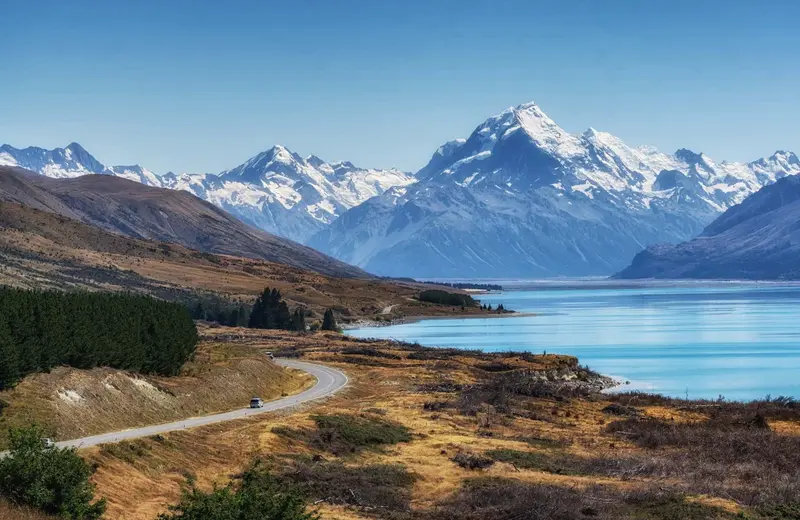
The drive from Queenstown to Wanaka, for example, winds through mountain passes and lake valleys that feel almost cinematic.
Pull over at a random viewpoint, step outside the car, and you’ll often find yourself surrounded by total stillness.
No buildings.
No traffic.
Just mountains reflected in water.
This kind of spontaneous stop often becomes the most memorable part of the trip.
Road trip tip: Always allow extra time for scenic drives. In New Zealand, the journey is often better than the destination.
Stargazing in Absolute Quiet
Silence becomes even more powerful at night.
The region around Lake Tekapo sits inside the Aoraki Mackenzie International Dark Sky Reserve, one of the largest protected dark-sky areas in the world.
Here, light pollution is minimal, and the night sky feels almost impossibly clear.
Standing under the Milky Way in complete quiet is an experience that borders on surreal.
At a stargazing lookout outside town, I remember hearing nothing but the faint rustle of wind across the hills. Above me, thousands of stars stretched across the sky.
It was the kind of moment that slows time.
You stop taking photos.
You stop checking your phone.
You just look up.
Helpful tip: Visit during a new moon for the darkest skies.
Finding Quiet Even in Popular Places
You don’t always need to travel to the most remote locations to experience silence in New Zealand.
Sometimes it’s simply about timing.
Take Tongariro National Park, home to one of the country’s most famous hikes, the Tongariro Alpine Crossing.
At midday, the trail can be busy.
But start at sunrise, and the experience feels completely different.
Early hikers move quietly across volcanic landscapes while mist drifts across emerald lakes and craters. For long stretches, you might hear nothing but wind and distant birds.
The lesson here is simple: arrive earlier than everyone else.
Quiet often exists just before the crowds appear.
Why Quiet Travel Matters
Travel often focuses on doing more—seeing more, moving faster, checking off bigger lists.
But destinations like New Zealand remind us that the opposite approach can be just as meaningful.
Silence has a strange effect on travelers. It clears mental clutter. It sharpens awareness. It turns ordinary moments—like standing beside a lake or walking through a forest—into something memorable.
New Zealand’s landscapes aren’t just photogenic; they’re therapeutic.
And in a world that rarely stops talking, that might be their most valuable quality.
The Memory That Stays With You
Long after returning home, the photos from New Zealand are beautiful.
But the images aren’t what stay with you the most.
It’s the quiet moments:
-
Standing beside a still lake at dawn
-
Listening to wind move through alpine grass
-
Watching stars appear in a dark sky
-
Walking through forest with no one else around
Those are the memories that linger.
Because sometimes the most powerful travel experiences aren’t about what you hear.
They’re about what disappears.
And in New Zealand, silence isn’t empty at all.
It’s full of life.