Most foreign visitors heading down the Gulf coast aim straight for Hua Hin, with its royal history and its big resorts. Drive twenty-five kilometres north and you reach Cha-Am Beach, the place those same Thai families actually pick for a weekend by the sea. It is longer, cheaper, and far more local: rows of deckchairs under casuarina pines, vendors carrying grilled squid down to your umbrella, and a crowd that is overwhelmingly Thai rather than international. Nobody will tell you Cha-Am has the finest sand in Thailand, because it does not. What it has is an easy, unpretentious beach day a couple of hours from Bangkok, and this guide lays out how to get there, when to go, and what to do once you arrive.
Hua Hin's down-to-earth neighbour up the coast, where Bangkok's weekend crowd eats seafood under the pines and nobody is putting on a show.
| At a glance | Details |
|---|---|
| Where | Phetchaburi Province, Gulf of Thailand, central Thailand |
| Distance | About 170 to 200 km south of Bangkok; 25 km north of Hua Hin |
| Known for | A long, pine-shaded beach popular with Thai weekenders |
| Vibe | Low-key, family-friendly, affordable, very Thai |
| Getting there | Minivan, train, or car from Bangkok in roughly 2.5 to 3 hours |
| Best for | Cheap weekend beach days, seafood, families, slow trips |
| Best season | Cool, dry months, roughly November to February |
| Honest note | Sand and water are not postcard-perfect; the value is the point |
Cha-Am vs Hua Hin: The Honest Comparison
This is the question almost everyone asks, so here it is straight. Hua Hin is bigger, more polished, and has the better beach, the upscale hotels, the night markets, and more to do when you tire of the sand. Cha-Am is smaller, rougher around the edges, and noticeably cheaper, with a beach that draws middle-class Thai families rather than an international crowd.
Which is better depends entirely on what you want. If you are after resort comfort, dining variety, and a prettier shoreline, Hua Hin earns its reputation. If you want a cheaper, more relaxed, more authentically Thai beach day and do not mind that the place is a little scruffy, Cha-Am makes sense, and the two are close enough that you can stay in one and visit the other.
Pick Hua Hin for polish and things to do; pick Cha-Am for a cheaper, quieter, more local beach. They sit twenty-five kilometres apart, so you do not really have to choose.
What the Beach Is Actually Like
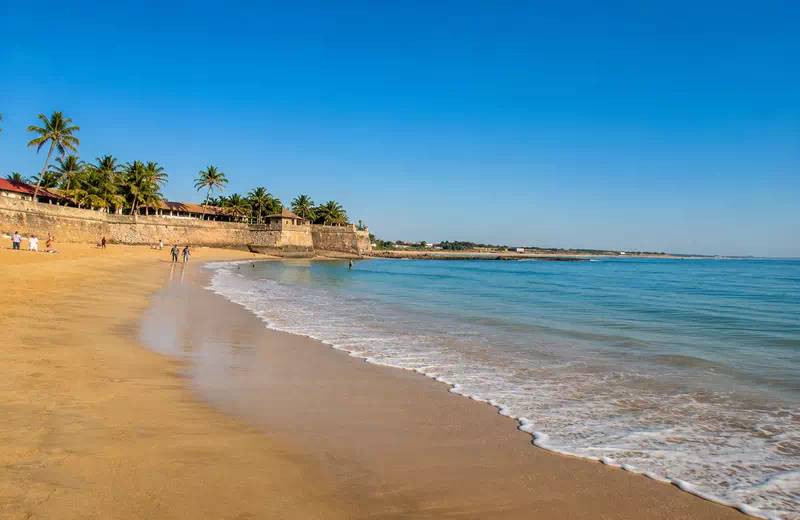
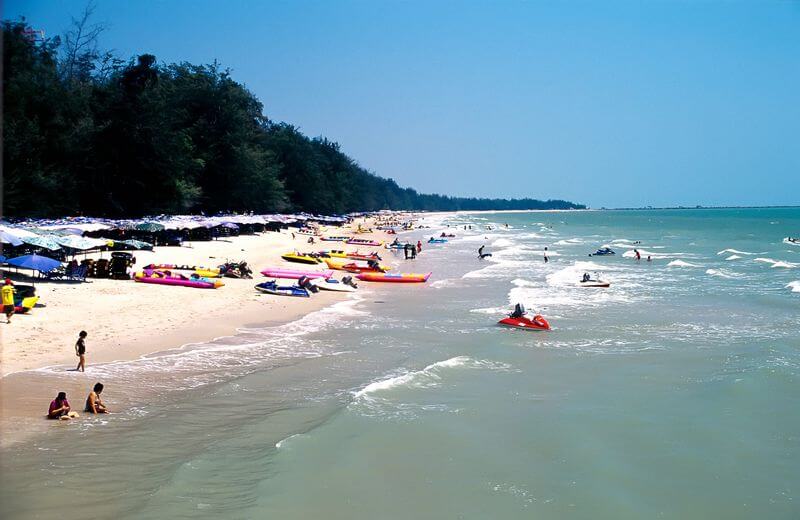
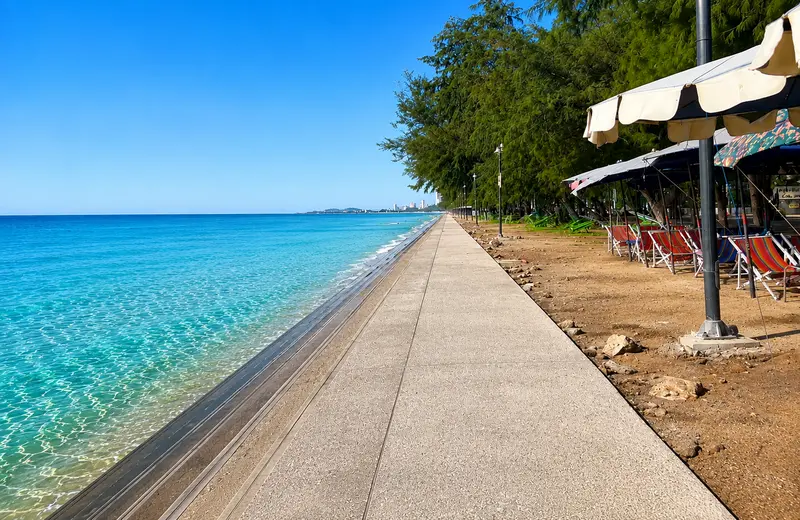
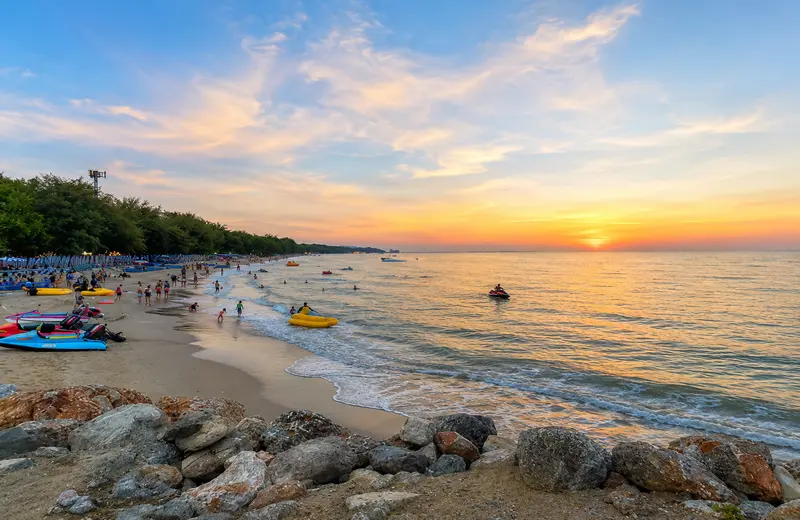
The defining feature of Cha-Am is the line of casuarina pines that shades the sand, and the rows of deckchairs and umbrellas set out beneath them. You rent a chair, and food comes to you: vendors work the beach selling grilled seafood, som tam, drinks, and snacks, so a lazy afternoon here mostly involves not moving. The water is shallow and gentle a long way out, which is why Thai parents like it for young children.
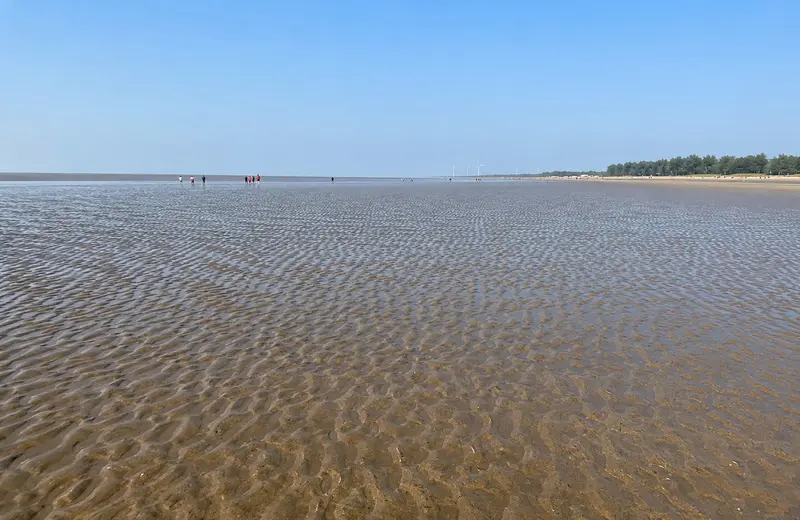
Be realistic about the setting. The sand is coarser and the water murkier than at Hua Hin or the southern islands, and you will see the odd street dog and a bit of litter on a busy weekend. The rhythm of the place also flips with the calendar: on weekends and Thai public holidays the beach fills with Bangkok families and the prices rise, while on a weekday it can feel close to deserted.
Come on a weekday if you can. Cha-Am is built around the Thai weekend, so Monday to Thursday you get the same beach at lower prices and a fraction of the crowd.
Best Time to Visit
The most comfortable window is the cool, dry season from around November to February, when the heat eases and rain is unlikely. March through May turns hot and humid, still fine for a beach but sweaty away from the water. The wetter months run roughly from May into October, though this upper stretch of the Gulf generally sees less rain than the Andaman coast, and showers often pass quickly.
Layered on top of the seasons is the weekly pattern. Whatever month you choose, a weekday visit is quieter and cheaper than a weekend, when half of Bangkok seems to arrive at once.
How to Reach Cha-Am
Cha-Am is one of the easier beaches to reach from Bangkok, with several options and no ferries involved.
Minivans are the most popular choice. They run frequently from Bangkok's Southern Bus Terminal (Sai Tai Mai), with less frequent services from the Ekkamai and Mochit terminals, and take a little under three hours for a low fare, dropping you in the centre of Cha-Am. The train is the cheapest way down, leaving from Bangkok's main rail terminal on the southern line, though you arrive at Ban Cha-Am station a couple of kilometres outside town and there are only a few services a day. A private taxi or your own car covers the trip in about two and a half hours depending on traffic.
If you are already in Hua Hin, Cha-Am is a quick hop of around twenty-five kilometres north, roughly thirty to forty minutes by taxi, songthaew, or any of the buses running between the two. Note that all Bangkok-to-Hua Hin buses pass through Cha-Am anyway, so you are rarely short of a ride.
Things to Do Around Cha-Am
On the beach itself, the active options are the standard Thai-seaside set: jet skis, banana-boat rides, inflatable tubes, and the occasional horse plodding along the sand for hire. Mostly, though, people come to sit, swim, and eat.
The bigger draw is what sits just inland and along the road to Hua Hin. The standout is Maruekhathaiyawan Palace, a golden-teak summer palace raised on stilts by the sea, built in the 1920s for King Rama VI, and an easy, atmospheric stop between the two towns. Inland in Phetchaburi town, the hilltop palace and temple complex of Phra Nakhon Khiri, known locally as Khao Wang, looks out over the province and comes with a resident troop of macaques. Further west lies Kaeng Krachan, the largest national park in Thailand, a serious wildlife and forest destination for anyone wanting a day away from the coast. Closer to hand, the road between Cha-Am and Hua Hin is dotted with family theme parks and photo-spot attractions, and a Hua Hin vineyard runs tours and tastings in the hills.
Build in at least one half-day off the sand. Maruekhathaiyawan Palace and the Khao Wang hilltop in Phetchaburi town are the two that reward the short drive most.
For ideas beyond this stretch of coast, it is worth seeing how Cha-Am compares with the country's most beautiful beaches, and the Phetchaburi area's royal hill temples sit comfortably among Thailand's most striking temples.
Where to Stay and Eat
Accommodation in Cha-Am skews cheaper than Hua Hin across the board, running from simple guesthouses a block from the sand to a handful of larger beachfront resorts along the main road. For a wider choice of hotels, nightlife, and restaurants, Hua Hin is close enough to use as a base while day-tripping to Cha-Am, or the other way round.
Food here means seafood, first and last. The beachfront restaurants and the chair-side vendors both trade on the day's catch, and prices stay friendly. For night-market grazing and more variety you will likely drift toward Hua Hin in the evening, but for a fresh, cheap seafood lunch with your feet near the water, Cha-Am holds its own.
A Few Practical Tips
Bring cash, since smaller restaurants, chair rentals, and beach vendors will not take cards and ATMs are limited. Keep your expectations calibrated: this is a working Thai beach town, not a manicured resort, and the soi dogs and weekend litter come with that territory. If you are travelling with small children, the shallow water is a genuine plus. And when you head inland to Kaeng Krachan or the hill parks, the usual habits of travelling responsibly in Thailand matter, especially around the macaques, which you should never feed.
If you want to compare Cha-Am with other easy beach escapes from Bangkok, the eastern-Gulf options of Ao Prao on Koh Samet and the busier sands of Sai Kaew near Pattaya make useful points of reference.
Wrap-Up
Cha-Am is not chasing the postcard, and that honesty is its appeal: a long, pine-shaded, deckchair-and-seafood beach where Bangkok comes to relax cheaply, just up the coast from glossier Hua Hin. Go in the cool season, go on a weekday for the quiet, lean on the train or a minivan to get there, and set aside an afternoon for a teak palace or a hilltop temple inland. The simple plan: book a weekday minivan from Bangkok, rent a chair under the pines, and let the seafood come to you.